Government of India
Videos
The Government of India is the national authority of the Republic of India, established in accordance with the Constitution of India. As outlined in Part I, India is a "Union of States", a term often

Governor-General of India C. Rajagopalachari declaring India a republic at Government House on 26 January 1950

Parliament House in New Delhi

President Droupadi Murmu (center), Vice President C. P. Radhakrishnan (left), and Prime Minister Narendra Modi

North and South Blocks of the Central Secretariat housing various ministries of the Government of India, with the Rashtrapati Bhavan visible in the distance
Prime Minister of India
Videos
The prime minister of India is the head of government of the Republic of India. Executive authority is vested in the prime minister and his chosen Council of Ministers, despite the President of India
Government of India
…president of India, who, as the ceremonial Head of state, holds formal executive power. Dictated by parliamentary elections, the president appoints the prime minister as the head of government, along with other ministers. India is divided into 28 states and 8 union territories, making a total of 36 subnational entities…

The official portrait of Shri Narendra Modi, the Prime Minister of the Republic of India

Former Prime Minister Manmohan Singh with the former Prime Minister Atal Bihari Vajpayee in New Delhi on May 24, 2004

Prime minister Narendra Modi addressing the 69th United Nations General Assembly, c. 2014
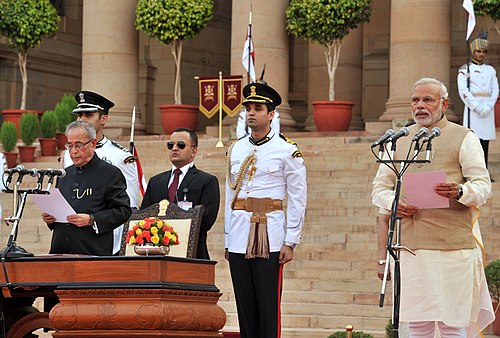
First swearing-in ceremony of Narendra Modi, 2014