Grand Tour
Videos
The Grand Tour was the principally 17th- to early 19th-century custom of a traditional trip through Europe, with Italy as a key destination, undertaken by upper-class young European men of sufficient

c. 1750 painting of six British gentlemen in Rome while on the Grand Tour
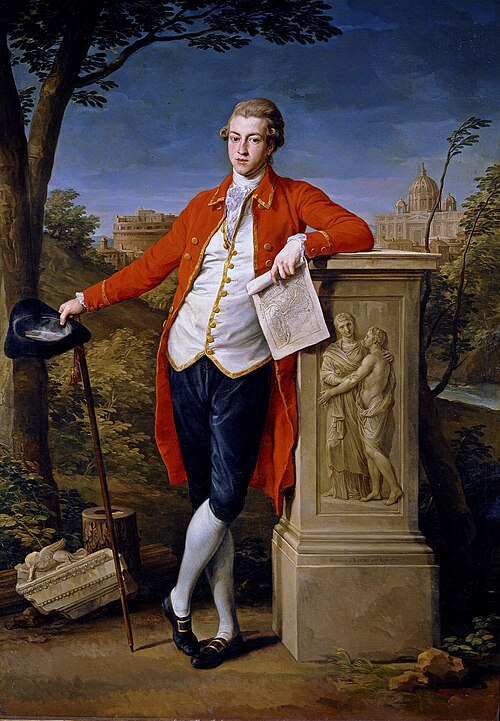
Portrait of Francis Basset by Pompeo Batoni, 1778. The Grand Tourist, like Francis Basset, would become familiar with antiquities, though this altar is an invention of the painter.[citation needed]

A portrait of Douglas, 8th Duke of Hamilton, on his Grand Tour with his physician Dr. John Moore and the latter's son John. A view of Geneva in the distance, where they stayed for two years. Painted by Jean Preudhomme in 1774.

Northerners found the contrast between Roman ruins and modern peasants of the Roman Campagna an educational lesson in vanity (vanitas). Painting by Nicolaes Pietersz Berchem, 1661, Mauritshuis
Pompeii
Videos
Pompeii was a city in what is now the municipality of Pompei, near Naples, in the Campania region of Italy. Along with Herculaneum, Stabiae, and many surrounding villas, it was buried under 4 to 6 m o
Grand Tour
…of painting the English milordi posed with graceful ease among Roman antiquities. Many continued on to Naples, where they also viewed Herculaneum and Pompeii, but few ventured far into Southern Italy, and fewer still to Greece, then still under Turkish rule. After the advent of steam-powered transportation…

View of Pompeii and Mount Vesuvius

The Forum of Pompeii with the entrances to the Basilica (left) and Macellum (right), the Temple of Jupiter (front) and Mount Vesuvius in the distance

Greek Doric Temple (6th century BC) in Triangular Forum

Etruscan Temple of Apollo