Great Northern War
Videos
In the Great Northern War a coalition led by Russia successfully contested the supremacy of Sweden in Northern, Central and Eastern Europe. The initial leaders of the anti-Swedish alliance were Peter
Top to bottom, left to right: Battle of Narva (1700) Crossing of the Düna (1701) Battle of Poltava (1709) Battle of Gadebusch (1712) Bringing Home the Body of King Charles XII (1718)


Swedish cavalry of the Västergötland Regiment

Russian guard of the Semyonovsky Regiment

Uniforms of two Danish guard regiments in 1703
Battle of Poltava
Videos
The Battle of Poltava fought on 8 July 1709, was the decisive and largest battle of the Great Northern War. A Russian army under the command of Tsar Peter I defeated a Swedish army commanded by Carl G
Great Northern War
…Sweden, under Charles XII, and forced out of the alliance in 1700 and 1706, respectively, but rejoined it in 1709 after the defeat of Charles XII at the Battle of Poltava. George I of Great Britain and the Electorate of Hanover joined the coalition in 1714 for Hanover and in 1717 for Britain, and Frederick William I of…
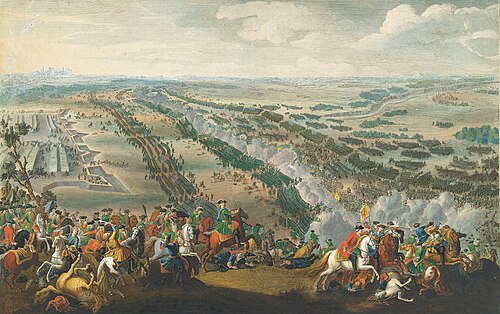
The Battle of Poltava by Pierre-Denis Martin

The Battle of Poltava, mosaic by Mikhail Lomonosov

The Victory at Poltava by Alexander Kotzebue