Great Purge
Videos
The Great Purge or Great Terror, also known as the Year of '37 and the Yezhovshchina, was a political purge in the Soviet Union from 1936 to 1938. After the assassination of Sergei Kirov by Leonid Nik
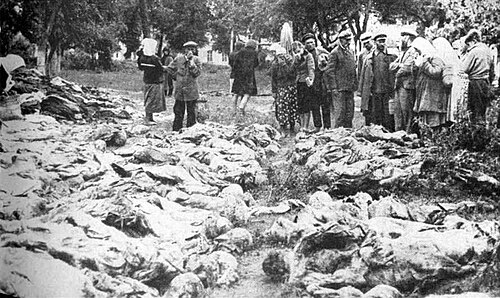
Residents searching for relatives among the exhumed victims of the Vinnytsia massacre, 1943

Excerpt from NKVD Order No. 00447

Leningrad party leader Sergei Kirov with Stalin and his daughter, Svetlana, in 1934

Bolshevik revolutionaries Leon Trotsky, Lev Kamenev, and Grigory Zinoviev
Sergei Kirov
Videos
Sergei Mironovich Kirov was a Russian and Soviet politician and Bolshevik revolutionary. Kirov was an early revolutionary in the Russian Empire and a member of the Bolshevik faction of the Russian Soc
Great Purge
…and the Yezhovshchina (ежовщина , lit. 'period of Yezhov'), was a political purge in the Soviet Union from 1936 to 1938. After the assassination of Sergei Kirov by Leonid Nikolaev in 1934, Joseph Stalin launched a series of show trials known as the Moscow trials to remove suspected dissenters from the Communist…

Kirov c. 1930s

Kirov as a child, 1893

Kirov (right) with Felix Dzerzhinsky in Leningrad, 1926

Kirov at the 17th Congress of the Communist Party in 1934