Hadrian's Wall
Videos
Hadrian's Wall is a former defensive fortification of the Roman province of Britannia, begun in AD 122 in the reign of the Emperor Hadrian. Running from Wallsend on the River Tyne in the east to Bowne

A view of a partially-reconstructed section of Hadrian's Wall. The upright stones on top are a modern addition, to deter people from walking on it.
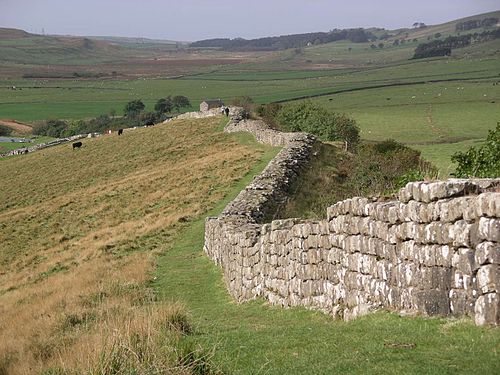
Sections of Hadrian's Wall still remain, particularly in its hilly central sector. Little remains in lowland regions, where it was used as a source of stone for new buildings.

Hadrian's Wall facing east towards Crag Lough (the lake in the picture). The rocky outcrop is the Whin Sill, of volcanic origin.

Bronze head of the Emperor Hadrian, who commissioned the wall's construction, found in 1834 in the River Thames in London, around 280 miles (450 km) south of Hadrian's Wall
Antonine Wall
Videos
The Antonine Wall was a turf fortification on stone foundations, built by the Romans across what is now the Central Belt of Scotland, between the Firth of Clyde and the Firth of Forth. Built some twen
Hadrian's Wall
…icon, Hadrian's Wall is one of Britain's major ancient tourist attractions. It was designated a UNESCO World Heritage Site in 1987. The turf-built Antonine Wall of AD 142 in what is now central Scotland, which briefly superseded Hadrian's Wall before being abandoned, was declared a World Heritage Site in 2008…

Antonine Wall near Bar Hill showing ditch

Stone foundation of the Wall in Bearsden, Glasgow

Forts and Fortlets associated with the Antonine Wall from west to east: Bishopton, Old Kilpatrick, Duntocher, Cleddans, Castlehill, Bearsden, Summerston, Balmuildy, Wilderness Plantation, Cadder, Glasgow Bridge, Kirkintilloch, Auchendavy, Bar Hill, Croy Hill, Westerwood, Castlecary, Seabegs, Rough Castle, Camelon, Watling Lodge, Falkirk, Mumrills, Inveravon, Kinneil, Carriden

The Bridgeness Slab – the easternmost distance slab