Han–Xiongnu wars
Videos
The Han–Xiongnu wars or Sino–Xiongnu wars, were a series of military conflicts fought from 133 BC to 89 AD between the agrarian Chinese Han dynasty and the nomadic pastoralist Xiongnu confederacy, alt

Emperor Wu dispatching the diplomat Zhang Qian to Central Asia, Mogao Caves mural, 8th century

Emperor Wu of Han
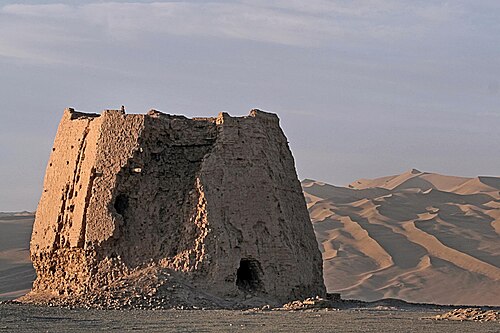
The ruins of a Han rammed-earth watchtower in Dunhuang

Painted ceramic statues of Chinese cavalrymen and infantrymen, from the Western Han period (202 BC – 9 AD)
Xiongnu
Videos
The Xiongnu were a tribal confederation of nomadic peoples who, according to ancient Chinese sources, inhabited the eastern Eurasian Steppe from the 3rd century BC to the late 1st century AD. Modu Cha
Han–Xiongnu wars
…Sino–Xiongnu wars, were a series of military conflicts fought from 133 BC to 89 AD between the agrarian Chinese Han dynasty and the nomadic pastoralist Xiongnu confederacy, although extended conflicts can be traced back as early as 200 BC and as late as 188 AD. The Chinese civilization initially clashed with…

A gold crown belonging to a Xiongnu king, from the early Xiongnu period. Seen at the top of a crown is an eagle with a turquoise head.

Xiongnu chief, 2nd century BC – 1st century AD. Reconstruction by archaeologist A. N. Podushkin, in the Central State Museum of Kazakhstan.

A traveling nomad family led by a man in belted jacket and trousers, pulling a nomadic cart. Belt Buckle, Mongolia or southern Siberia, dated to 2nd–1st century BC (Xiongnu period).

Belt plaque with design of wrestling men, Ordos region and western part of North China, 2nd century BC, bronze - Ethnological Museum, Berlin. According to Frankfort, the wrestlers are Xiongnu, and their horses have Xiongnu-type horse trappings.