Haori
Videos
A haori is a traditional Japanese jacket worn over a kimono. Resembling a shortened kimono with no overlapping front panels, the haori typically features a thinner collar than that of a kimono, and is
A formal haori with two traditional Japanese emblems visible from the front


Kitanoumi Toshimitsu wearing a formal black haori with emblems (a kuromontsuki haori); it is tied at the front with two white haori himo.
Geisha
Videos
Geisha, also known as geiko or geigi, are female Japanese performing artists and entertainers trained in traditional Japanese performing arts styles, such as dance, music and singing, as well as being
Haori
…men began to wear haori with plain external designs and lavishly decorated linings, a trend still seen in men's haori today. During the early 1800s, geisha in the hanamachi of Fukagawa, Tokyo began to wear haori over their kimono. Haori had until that point only been worn by men; the geisha of Fukagawa…

Profile of a Miyagawa-chō geiko (geisha) Kimiha wearing a trailing, formal black kimono (kuromontsuki hikizuri) and a chū taka shimada-style nihongami wig

A shikomi (left) accompanying the maiko Takamari of the Kaida okiya in Gion Kobu
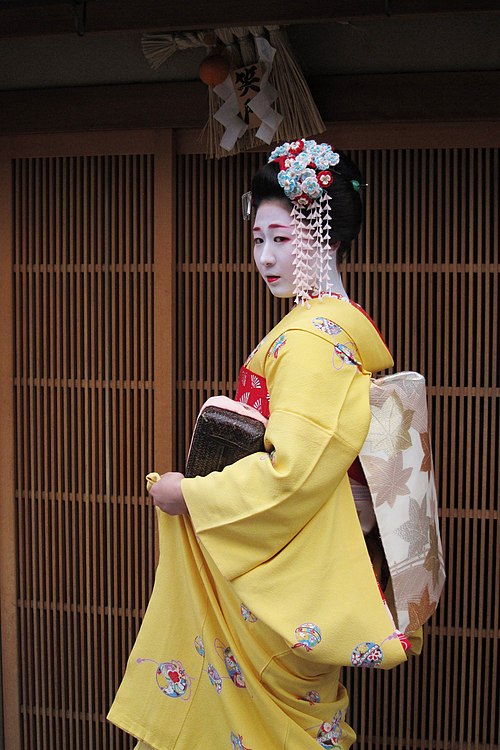
Minarai Katsunosuke wearing a short obi and a large, colourful set of kanzashi hairpins

Ukiyo-e scroll depicting a Gion geisha, 1800–1833