Harpsichord
Videos
A harpsichord is a keyboard instrument that makes its sound by plucking a set of strings. In a harpsichord, depressing a key raises its back end within the instrument, which in turn lifts one or more
This harpsichord is the work of two celebrated makers: originally constructed by Andreas Ruckers in Antwerp (1646), it was later remodeled and expanded in a process called grand ravalement by Pascal Taskin in Paris (1780).

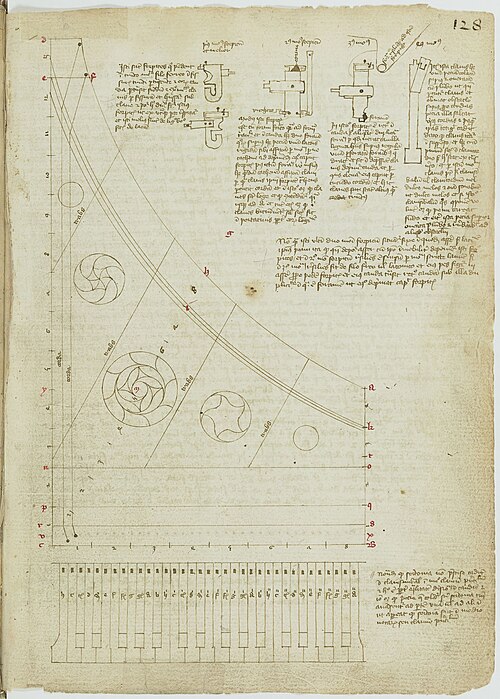
An early diagram of a vertical harpsichord (clavicytherium) by Arnault de Zwolle, c. 1430

Harpsichord by Christian Zell, at Museu de la Música de Barcelona. From upper left to lower right: a bridge (supporting the far ends of the strings), the jack rail with the action (jacks) underneath, two nuts (supporting the closer ends of the strings), interleaved with two rows of tuning pins, and finally the keyboard. As with all harpsichords, the action itself is mostly hidden by the jack rail when the instrument is being played; only by removing the jack rail (or indeed, by extracting a jack) can the details of the action be observed.

Sound board of a harpsichord with Chladni patterns
Virginals
Videos
The virginals is a keyboard instrument of the harpsichord family. It was popular in Europe during the late Renaissance and early Baroque periods.
Harpsichord
…instruments the deployment of more than one keyboard. The term denotes the whole family of similar plucked-keyboard instruments, including the smaller virginals, muselar, and spinet. The harpsichord was widely used in Renaissance and Baroque music, both for purposes of accompaniment and as a solo instrument…

Flemish virginals by Hans Ruckers, 1583, Antwerp (Paris, Musée de la Musique). Note the inset keyboard placed left of centre.

An Italian spinetta or virginals after Alessandro Bertolotti, c. 1586, provided with a false outer case. Note the projecting keyboard, unlike the inset Flemish examples.

Woman at a Muselar, by Johannes Vermeer, c. 1672 (National Gallery, London). Note the keyboard placed to the right.

A typical muselar of the Ruckers school. Note the keyboard on the right of the case.