Hauyne or haüyne, also called hauynite or haüynite, is a Rare tectosilicate sulfate mineral with endmember formula Na3Ca(Si3Al3)O12(SO4). As much as 5 wt % K2O may be present, and also H2O and Cl. It is a feldspathoid and a member of the sodalite group. Hauyne was first described in 1807 from samples discovered in Vesuvian lavas in Monte Somma, Italy, and was named in 1807 by Brunn-Neergard for the French crystallographer René Just Haüy (1743–1822). It is sometimes used as a gemstone.
Hauyne from Mayen, Eifel Mts, Rhineland-Palatinate, Germany
A six-sided phenocryst of haüyne (diameter about 1 mm) surrounded by a fine-grained groundmass in a foidite (volcanic rock) from Melfi (Italy), as seen in thin section under a petrographic microscope
Silicate minerals are rock-forming minerals made up of silicate groups. They are the largest and most important class of minerals and make up approximately 90 percent of Earth's crust.
Lithium aluminium silicate mineral spodumene
Diatomaceous earth, a biogenic form of silica as viewed under a microscope. The imaged region measures approximately 1.13 by 0.69 mm.
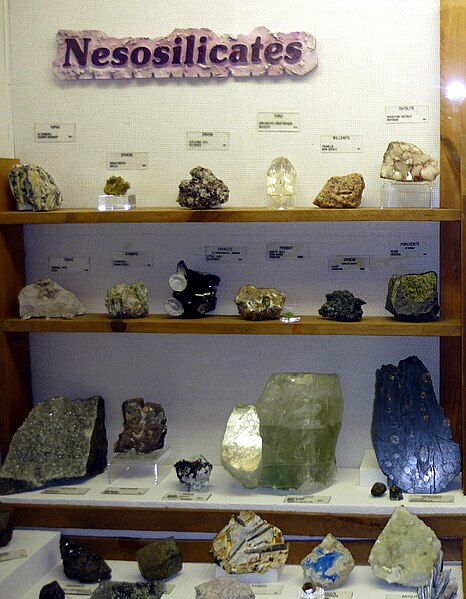
Nesosilicate specimens at the Museum of Geology in South Dakota
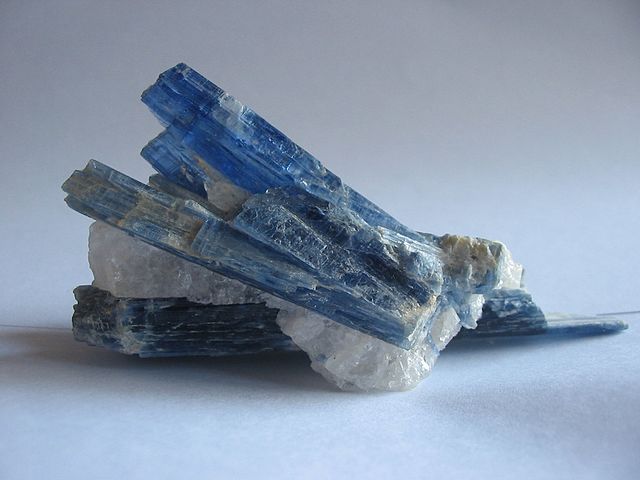
Kyanite crystals (unknown scale)