Hay
Videos
Hay is grass, legumes, or other herbaceous plants that have been cut and dried to be stored for use as animal fodder, either for large grazing animals raised as livestock, such as cattle, horses, goat

Baled cornstalks

Good-quality hay is green and not too coarse and includes plant heads, leaves, and stems.

Poor-quality hay is dry, bleached out and coarse-stemmed. Sometimes, hay stored outdoors will look like this on the outside but still be green inside the bale. A dried, bleached or coarse bale is still edible and provides some nutritional value as long as it is dry and not moldy, dusty, or rotting.
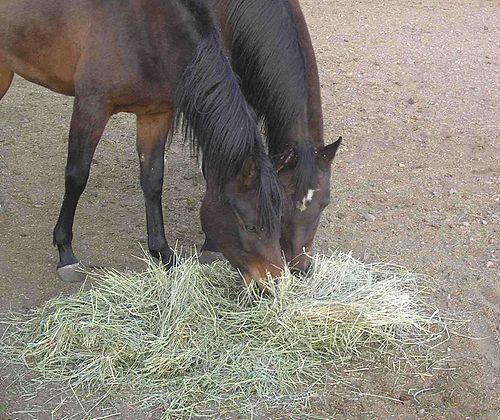
Horses eating hay
Silage
Videos
Silage is fodder made from green foliage crops which have been preserved by fermentation to the point of souring. It is fed to cattle, sheep, and other ruminants. The fermentation and storage process
Hay
…to ferment. When it is possible to store round bales under a shed, they last longer, and less hay is lost to rot and moisture. For animals that eat silage, a bale wrapper may be used to seal a round bale completely and trigger the fermentation process. It is a technique used as a money-saving process by…

Silage underneath plastic sheeting is held down by scrap tires. Concrete beneath the silage prevents fermented juice from leaching out.

Cattle eating silage

MB Trac rolling a silage heap or "clamp" in Victoria, Australia

Partially dried mown grass is formed into cylindrical bales in the field (above) and sealed in polywrap (below).