Heavy cruiser
Videos
A heavy cruiser was a type of cruiser, a naval warship designed for long range and high speed, armed generally with naval guns of roughly 203 mm in calibre, whose design parameters were dictated by th

HMS Frobisher, a Hawkins-class cruiser around which the Washington Naval Treaty limits for heavy cruisers were written.
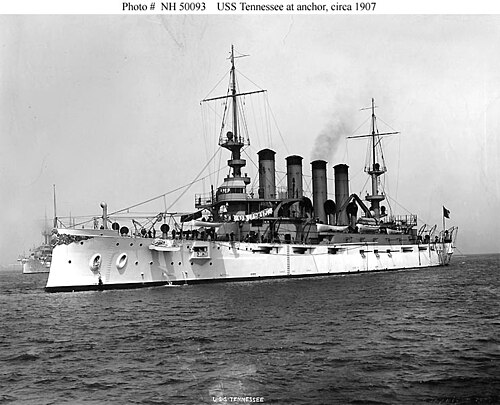
Armoured cruiser USS Tennessee (1906), armed with four 10-inch (250 mm) guns, ca. 1907

HMS Hawkins, lead ship of her class, commissioned in 1919

HMAS Canberra, a County-class "treaty cruiser".
Light cruiser
Videos
A light cruiser was a type of small or medium-sized warship. The term is a shortening of the phrase "light armored cruiser", describing a small ship that carried armor in the same way as an armored cr
Heavy cruiser
…Naval Treaty of 1922 and the London Naval Treaty of 1930. Heavy cruisers were generally larger, more heavily armed and more heavily armoured than light cruisers while being smaller, faster, and more lightly armed and armoured than battlecruisers and battleships. Heavy cruisers were not considered capital ships…

HMS Belfast, one of the last surviving light cruisers. She carries 12 6-inch guns and displaces 11,553 tons – "light" in World War II referred to gun size, not displacement.

HMS Mercury

HMS Gloucester, one of the Town class, in 1917

SMS Bremen