Hegemony or Survival: America's Quest for Global Dominance is a book about the United States and its foreign policy written by American political activist and linguist Noam Chomsky. It was first published in the United States in November 2003 by Metropolitan Books and then in the United Kingdom by Penguin Books. It was republished by Haymarket Books in January 2024.
First edition cover
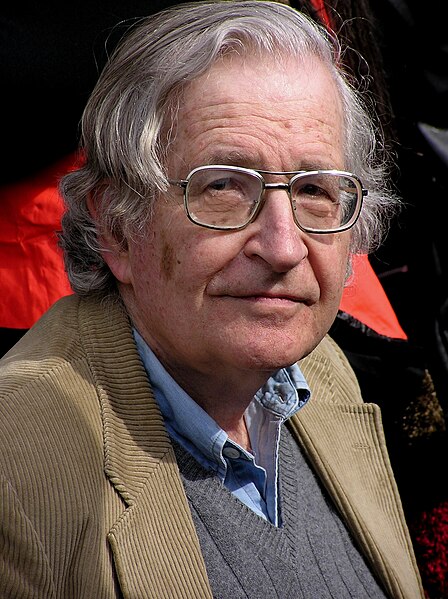
Chomsky in 2004
Chomsky considers the 2003 U.S.-U.K. invasion of Iraq – contravening international law and rejecting the opinions of the world's populace – as an attempt to secure lucrative natural resources and global hegemony.
Chomsky argues that U.S. government attempts to solve the Israeli–Palestinian conflict, such as the 1994 Oslo Accords (shown here), have been a sham, continually favoring Israeli-U.S. interests. From left to right: Israeli Prime Minister Yitzhak Rabin, U.S. president Bill Clinton, and PLO chairman Yasser Arafat.
Avram Noam Chomsky is an American professor and public intellectual known for his work in linguistics, political activism, and social criticism. Sometimes called "the father of modern linguistics", Chomsky is also a major figure in analytic philosophy and one of the founders of the field of cognitive science. He is a laureate professor of linguistics at the University of Arizona and an institute professor emeritus at the Massachusetts Institute of Technology (MIT). Among the most cited living authors, Chomsky has written more than 150 books on topics such as linguistics, war, and politics. Ideologically, he aligns with anarcho-syndicalism and libertarian socialism.
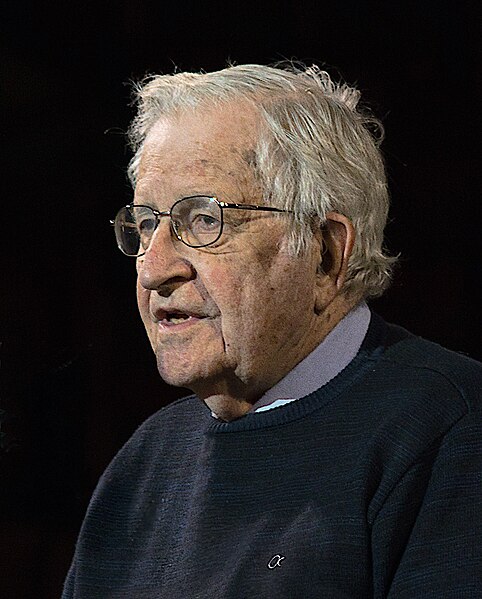
Chomsky in 2017
Carol Schatz married Chomsky in 1949.
The Great Dome at the Massachusetts Institute of Technology (MIT); Chomsky began working at MIT in 1955.
Chomsky in 1977