A helical antenna is an antenna consisting of one or more conducting wires wound in the form of a helix. A helical antenna made of one helical wire, the most common type, is called monofilar, while antennas with two or four wires in a helix are called bifilar, or quadrifilar, respectively.
Array of four axial-mode helical antennas used as a satellite tracking-acquisition antenna, Pleumeur-Bodou, France
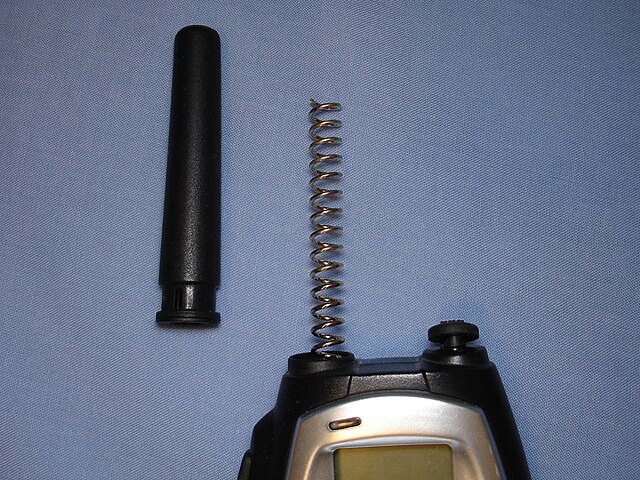
A common form of normal-mode helical antenna is the "rubber ducky antenna" used in portable radios. A handheld two-way radio, with the rubber sleeve removed from the antenna.
Normal-mode helical UHF TV broadcasting antenna, 1954
End-fire helical satellite communications antenna, Scott Air Force base, Illinois, USA. Satellite communication systems often use circularly polarized radio waves, because the satellite antenna may be oriented at any angle in space without affecting the transmission, and axial-mode (end-fire) helical antennas are often used as the ground antenna.
In radio engineering, an antenna or aerial is the interface between radio waves propagating through space and electric currents moving in metal conductors, used with a transmitter or receiver. In transmission, a radio transmitter supplies an electric current to the antenna's terminals, and the antenna radiates the energy from the current as electromagnetic waves. In reception, an antenna intercepts some of the power of a radio wave in order to produce an electric current at its terminals, that is applied to a receiver to be amplified. Antennas are essential components of all radio equipment.
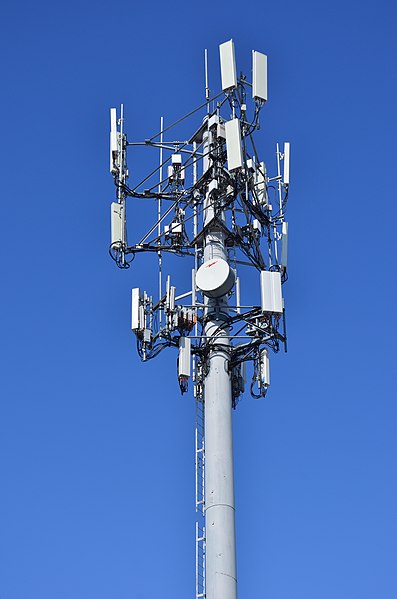
Multiple patch (rectangular) antennas found atop a Cellular Tower
Antennas of the Atacama Large Millimeter/submillimeter Array
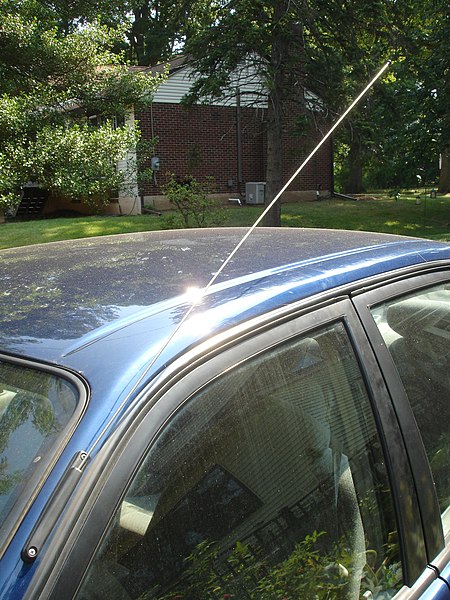
An automobile's whip antenna, a common example of an omnidirectional antenna
Half-wave dipole antenna