Henry Arnold Karo was a vice admiral in the former United States Coast and Geodetic Survey Corps, which is today known as the National Oceanic and Atmospheric Administration Commissioned Officer Corps. Vice Admiral Karo spent most of his working career in the United States Coast and Geodetic Survey, which provided coastal maps and charts for the United States. He rose through the organization's bureaucracy to become the director of the Survey.
A handwritten inscription on photograph of Admiral Chester Nimitz signing the Japanese surrender document reads, "To Rear Admiral H. Arnold Karo, USC&GS -- with best wishes and great appreciation of the assistance of the U.S. Coast and Geodetic Survey in making possible the above scene." C.W. Nimitz, Fleet Admiral, U.S. Navy.
Robert Francis Anthony Studds
Rear Admiral Robert Francis Anthony Studds was a career officer in the United States Coast and Geodetic Survey Corps, predecessor of the National Oceanic and Atmospheric Administration Commissioned Officer Corps. He served as the fourth Director of the United States Coast and Geodetic Survey.
Studds as officer-in-charge of USC&GS Elsie III on the Cooper River in South Carolina sometime between 1926 and 1929.
Fathomer aground in the inner harbor at Port San Vicente, Luzon, in the Philippine Islands, after the typhoon of August 15, 1936. The size of the waves in the inner harbor can be estimated by the height of Fathomer's port side above the water; at the height of the typhoon, waves broke over her crewmen as they sheltered there.
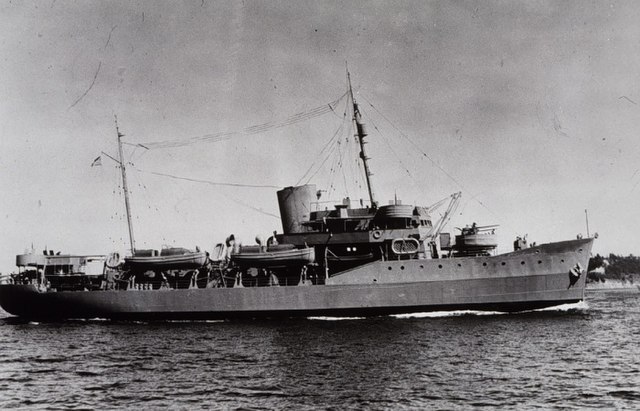
Studds commanded USC&GS Pathfinder (OSS 30) in the Aleutian Islands in the years following World War II.