Henry Ford
Videos
Henry Ford was an American industrialist and business magnate. As the founder of the Ford Motor Company, he is credited as a pioneer in making automobiles affordable for middle-class Americans through
Henry Ford in 1888 (aged 25)


Henry Ford sits in his first automobile, the Quadricycle, in 1896.

Henry Ford with Thomas Edison and Harvey S. Firestone. Fort Myers, Florida, February 11, 1929.

Ford assembly line, 1913
Ford Motor Company
Videos
The Ford Motor Company is an American multinational automobile manufacturer headquartered in Dearborn, Michigan, United States. It was founded by Henry Ford and incorporated on June 16, 1903. The comp
Henry Ford
…Henry Ford (July 30, 1863 – April 7, 1947) was an American industrialist and business magnate. As the founder of the Ford Motor Company, he is credited as a pioneer in making automobiles affordable for middle-class Americans through the system that came to be known as Fordism. In 1911…

Headquarters in Dearborn, Michigan
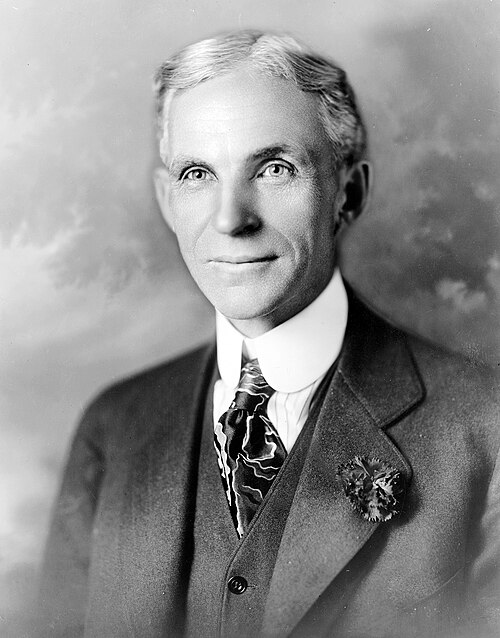
Founder Henry Ford, 1919

A 1910 Model T, introduced in 1908, photographed in Salt Lake City

Ford Model AA truck (based on the Model A) displayed in Kilgore, Texas