Henry Sully
Videos
Henry Sully was an English clockmaker. He was an apprentice and then journeyman for celebrated English clockmaker and watchmaker Charles Gretton. He lived in France for many years.
Henry Sully (1680-1729).

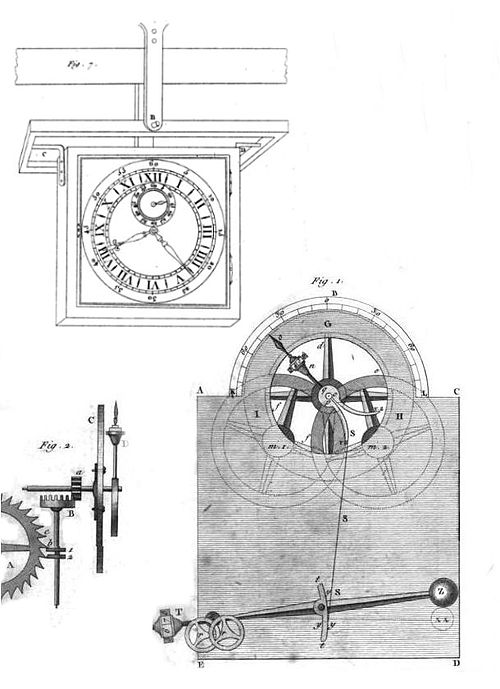
Henry Sully's clock (Fig.1) with escapement (Fig.2) and shipboard gimbaled suspension mechanism (Fig.7).

Henry Sully built the Gnomon of Saint-Sulpice.

Regle artificielle du temps, 1737
Marine chronometer
Videos
A marine chronometer is a precision timepiece that is carried on a ship and employed in the determination of the ship's position by celestial navigation. It is used to determine longitude by comparing

A marine chronometer by Charles Frodsham of London, shown turned upside down to reveal the movement. Chronometer circa 1844–1860.

The marine "Chronometer" of Jeremy Thacker used gimbals and a vacuum in a bell jar.

John Harrison's H1 marine chronometer of 1735