Henry VI, Holy Roman Emperor
Videos
Henry VI, a member of the Hohenstaufen dynasty, was King of Germany from 1169 and Holy Roman Emperor from 1191 until his death. From 1194, he was also King of Sicily as the husband and co-ruler of Que
Contemporary portrait from the Liber ad honorem Augusti, 1196

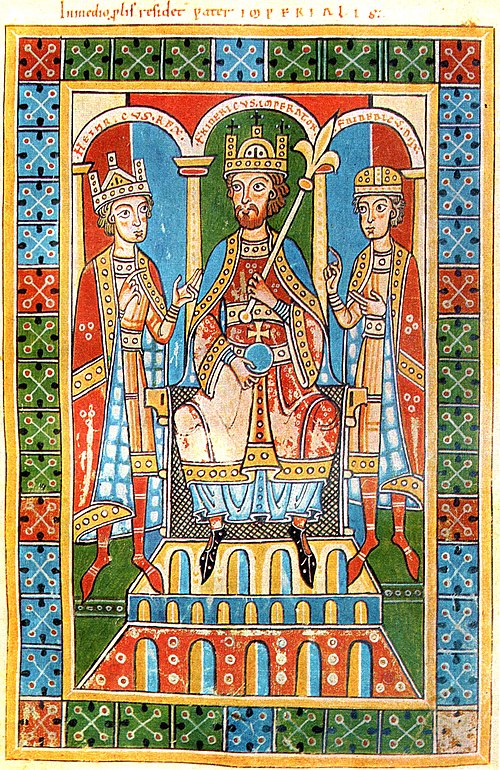
Frederick Barbarossa with his sons Henry and Frederick, Historia Welforum, Weingarten Abbey, c. 1180

Facsimile of the Imperial seal (1192)

Richard the Lionheart submits himself to Emperor Henry, Liber ad honorem Augusti, fol. 129R
Frederick II was King of Sicily from 1198, King of Germany from 1212, King of Italy and Holy Roman Emperor from 1220, and King of Jerusalem from 1225 to 1228. He was the son of Emperor Henry VI, of th
Henry VI, Holy Roman Emperor
…of Sicily and was crowned king on 25 December. On the next day his wife Constance, who had stayed back in Iesi, gave birth to his only son and heir Frederick II, the future emperor and king of Sicily and Jerusalem. The young William and his mother Sibylla had fled to Caltabellotta Castle; he officially renounced…
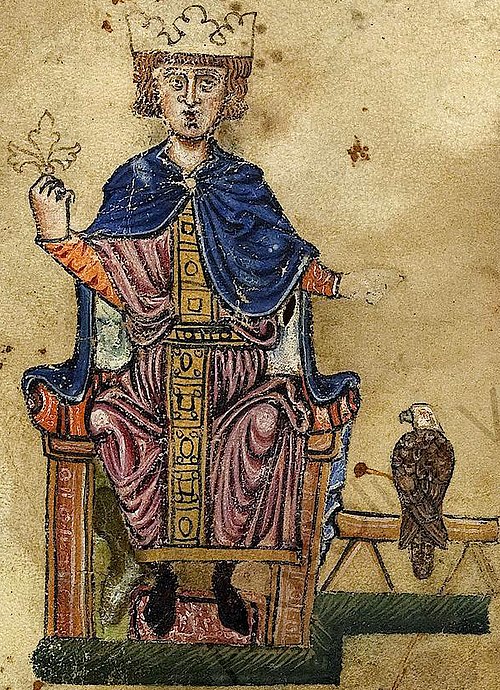
Contemporary portrait of Frederick II from the "Manfred manuscript" (Biblioteca Vaticana, Pal. lat 1071) of De arte venandi cum avibus

The birth of Frederick on the market square of Jesi from the Nuova Cronica, Biblioteca Apostolica Vaticana, ms. Chigi L. VIII.296 (cat. XI.8).

Constance handing her son over to the care of the duchess of Spoleto, the wife of Conrad of Urslingen, from the Liber ad honorem Augusti by Peter of Eboli.

Seals used by Frederick as Emperor (ed. Otto Posse 1909): 1: first Imperial seal (1221–1225), 2: second Imperial seal (1226), 3: third Imperial seal, addition of the title of King of Jerusalem (1226–1250) 4: seal used in 1221 and 1225, 5: first seal as King of Jerusalem (1233).