Hera
Videos
In ancient Greek religion, Hera is the goddess of marriage, women, and family, and the protector of women during childbirth. In Greek mythology, she is queen among the twelve Olympians on Mount Olympu
The Campana Hera, a Roman copy of a Hellenistic original, from the Louvre


Hera on an antique fresco from Pompeii
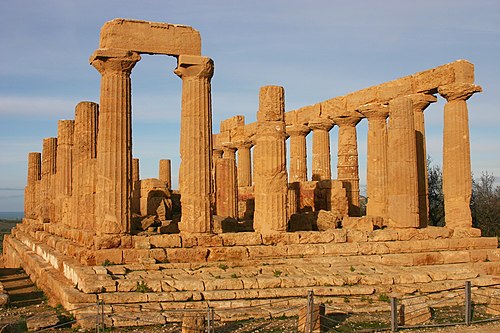
The Temple of Hera at Agrigento, Magna Graecia.

Iris (on the left) with Zeus and Hera, east frieze of the Parthenon, British Museum.
Twelve Olympians
Videos
In ancient Greek religion and mythology, the twelve Olympians are the major deities of the Greek pantheon, commonly considered to be Zeus, Poseidon, Hera, Demeter, Aphrodite, Athena, Artemis, Apollo,
Hera
…Homeric Greek) is the goddess of marriage, women, and family, and the protector of women during childbirth. In Greek mythology, she is queen among the twelve Olympians on Mount Olympus, sister and wife of Zeus, and daughter of the Titans Cronus and Rhea. One of her defining characteristics in myth is her jealous and…

Fragment of a Hellenistic relief (1st century BC–1st century AD) depicting the twelve Olympians carrying their attributes in procession; from left to right: Hestia (scepter), Hermes (winged cap and staff), Aphrodite (veiled), Ares (helmet and spear), Demeter (scepter and wheat sheaf), Hephaestus (staff), Hera (scepter), Poseidon (trident), Athena (owl and helmet), Zeus (thunderbolt and staff), Artemis (bow and quiver) and Apollo (lyre) from the Walters Art Museum.

Jupiter Smyrna Louvre Ma 13

Statue of Poseidon NAMA 235, part 2