Heresy
Videos
Heresy is any belief or theory that is strongly at variance with established beliefs or customs, particularly the accepted beliefs or religious law of a religious organization. A heretic is a proponent of heresy.

The Gospel triumphs over Heresia and the Serpent. Gustaf Vasa Church, Stockholm, Sweden, sculpture by Burchard Precht.

A statue in Vienna portraying Saint Ignatius of Loyola trampling on a heretic
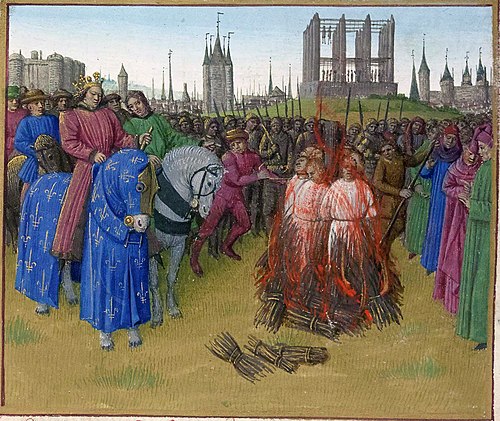
The burning of the pantheistic Amalrician heretics in 1210, in the presence of King Philip II Augustus. In the background is the Gibbet of Montfaucon and, anachronistically, the Grosse Tour of the Temple. Illumination from the Grandes Chroniques de France, c. AD 1455–1460.

Former German Catholic friar Martin Luther was famously excommunicated as a heretic by Pope Leo X by his papal bull Decet Romanum Pontificem in 1520. To this day, the papal decree has not been rescinded.
Irenaeus
Videos
Irenaeus was a Greek bishop noted for his role in guiding and expanding Christian communities in the southern regions of present-day France and, more widely, for the development of Christian theology by combating heterodox or Gnostic interpretations of Scripture as heresy and defining proto-orthodoxy. Originating from Smyrna, he had seen and heard the preaching of Polycarp, who in turn was said to have heard John the Evangelist, and thus was the last-known living connection with the Apostles.

20th-century Greek icon depicting Saint Irenaeus

Irenaeus, in Church of St Irenaeus, Lyon.

Cambridge University library manuscript 4113 / Papyrus Oxyrhynchus 405. Irenaeus. Ca. 200 AD.