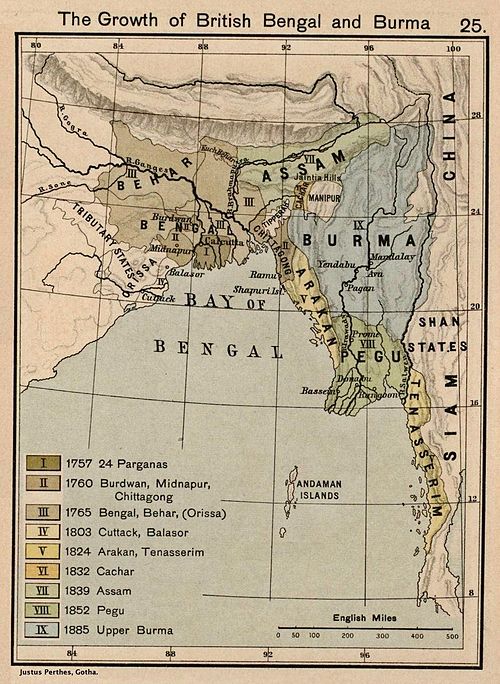
The city of Chattogram (Chittagong) is traditionally centred around its seaport which has existed since the 4th century BCE. One of the world's oldest ports with a functional natural harbor for centuries, Chittagong appeared on ancient Greek and Roman maps, including on Ptolemy's world map. Chittagong port is the oldest and largest natural seaport and the busiest port of Bay of Bengal. It was located on the southern branch of the Silk Road. The city was home to the ancient independent Buddhist kingdoms of Bengal like Samatata and Harikela. It later fell under of the rule of the Gupta Empire, the Gauda Kingdom, the Pala Empire, the Chandra Dynasty, the Sena Dynasty and the Deva Dynasty of eastern Bengal. Arab Muslims traded with the port from as early as the 9th century. Historian Lama Taranath is of the view that the Buddhist king Gopichandra had his capital at Chittagong in the 10th century. According to Tibetan tradition, this century marked the birth of Tantric Buddhism in the region. The region has been explored by numerous historic travellers, most notably Ibn Battuta of Morocco who visited in the 14th century. During this time, the region was conquered and incorporated into the independent Sonargaon Sultanate by Fakhruddin Mubarak Shah in 1340 AD. Sultan Ghiyasuddin Azam Shah constructed a highway from Chittagong to Chandpur and ordered the construction of many lavish mosques and tombs. After the defeat of the Sultan of Bengal Ghiyasuddin Mahmud Shah in the hands of Sher Shah Suri in 1538, the Arakanese Kingdom of Mrauk U managed to regain Chittagong. From this time onward, until its conquest by the Mughal Empire, the region was under the control of the Portuguese and the Magh pirates for 128 years.
The ancient shipbuilding industry at the Port of Chittagong provided for the entire fleet of Ottoman warships of the sultans in the 17th century.
Mughal-Arakanese battle on the Karnaphuli River in 1666
Ships moored off Chittagong in the late 1820s.
US Navy sailors in Chittagong, 1944
The Kingdom of Mrauk-U was a kingdom that existed on the Arakan littoral from 1429 to 1785. Based in the capital Mrauk-U, near the eastern coast of the Bay of Bengal, the kingdom ruled over what is now Rakhine State, Myanmar and southern part of Chittagong Division, Bangladesh. Though started out as a protectorate of the Bengal Sultanate from 1429 to 1531, Mrauk-U went on to conquer Chittagong with the help of the Portuguese. It twice fended off the Toungoo Burma's attempts to conquer the kingdom in 1546–1547, and 1580–1581. At its height of power, it briefly controlled the Bay of Bengal coastline from the Sundarbans to the Gulf of Martaban from 1599 to 1603. In 1666, it lost control of Chittagong after a war with the Mughal Empire. Its reign continued until 1785, when it was conquered by the Konbaung dynasty of Burma.
Image: Vista de Mrauk U, ou Arrakan (cidade de Arracão) no primeiro plano o bairro português
City walls of Mrauk U
Chittagong and Arakan in 1638