History of Christianity
Videos
The history of Christianity begins with Jesus, an itinerant Jewish preacher and teacher, who was crucified in Jerusalem c. AD 30–33. His followers proclaimed that he was the incarnation of God and had
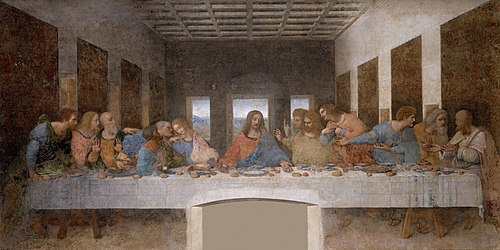
The Last Supper by Leonardo da Vinci (c. 1495) in the Santa Maria delle Grazie Church in Milan, Italy, depicts the final meal before Jesus' crucifixion and death.

Christ Crucified, by Diego Velázquez c. 1632, depicting the crucifixion of Jesus

Half-length portrait of a virgin consecrated to God, praying with an orante prayer position, from the book Die Malereien der Katakomben Roms, plate 80

The Trinity by Russian icon painter Andrei Rublev, early 15th century.
Protestantism
Videos
Protestantism is a form of Christianity that emphasizes justification of sinners through faith alone, the teaching that salvation comes by unmerited divine grace, the priesthood of all believers, and

The door to All Saints' Church in Wittenberg, where Martin Luther posted his Ninety-five Theses in 1517 detailing his concerns with what he saw as the Catholic Church's abuse and corruption. The original door was destroyed by a fire, and in 1857, King Frederick William IV of Prussia ordered that a replacement be made.

Memorial Church, finished and consecrated in 1904 in Speyer, Germany, commemorates the Protestation.

The Protesting Speyer, part of the Luther Monument in Worms, Germany

Two central figures of the Reformation, Martin Luther and John Calvin, depicted on a church pulpit; both Luther and Calvin emphasized making preaching a centerpiece of worship.