History of Jainism
Videos
Jainism is an ancient Indian religion belonging to the Śramaṇa tradition. Jains trace their history through a lineage of twenty-four tirthankaras, revering Rishabhanatha as the first in the present ti
Bahubali, son of Rishabhanatha (first Jain tirthankara), practicing meditation in standing Kayotsarga posture. (Photo: Gommateshwara statue, Shravanbelagola)


Triangular prism sealing from Indus Valley Civilisation, depicting a male cult figure seated in a yogic posture on a throne, a bull-like animal, and five characters in the Indus script. From Mohenjo-daro, Mature Harrapean period, c. 2600-1900 BC. Ashmolean Museum.

An 8th-century CE brass idol of Parshvanatha. It depicts the 23rd tirthankara, the earliest Jain leader accepted by scholars as a historical figure (c. 9th–8th century BCE), and illustrates the later artistic tradition associated with him.
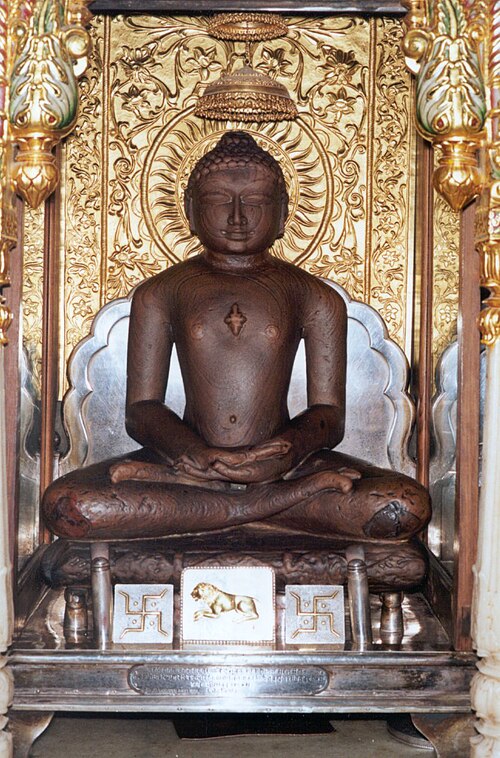
A modern depiction of Mahavira. As a contemporary of the Buddha, Mahavira is a key historical anchor, recognized by scholars as a reformer of the pre-existing Nigantha community.
History of India
Videos
Anatomically modern humans are estimated to have first arrived on the Indian subcontinent between 73,000 and 55,000 years ago. The earliest known human remains in South Asia date to 30,000 years ago.


Mesolithic rock art at the Bhimbetka rock shelters, Madhya Pradesh, showing a wild animal, perhaps a mythical one, attacking human hunters. Although the rock art has not been directly dated, it has been argued on circumstantial grounds that many paintings were completed by 8000 BCE, and some slightly earlier.

A dolmen erected by Neolithic people in Marayur, Kerala, India.

Stone Age (6,000 BCE) carvings of Edakkal Caves in Kerala, India.

Mehrgarh site in present-day Balochistan, Pakistan.