The history of ethanol fuel in Brazil dates from the 1970s and relates to Brazil's sugarcane-based ethanol fuel program, which allowed the country to become the world's second largest producer of ethanol, and the world's largest exporter. Several important political and technological developments led Brazil to become the world leader in the sustainable use of bioethanol, and a policy model for other developing countries in the tropical zone of Latin America, the Caribbean, and Africa. Government policies and technological advances also allowed the country to achieve a landmark in ethanol consumption, when ethanol retail sales surpassed 50% market share of the gasoline-powered vehicle fleet in early 2008. This level of ethanol fuel consumption had only been reached in Brazil once before, at the peak of the Pró-Álcool Program near the end of the 1980s.

Mechanized harvesting of sugarcane (Saccharum officinarum), Piracicaba, São Paulo.

A Dodge 1800 was the first prototype engineered with a neat ethanol-only engine. Exhibit at the Memorial Aeroespacial Brasileiro, CTA, São José dos Campos.

The Brazilian Fiat 147 was the first modern automobile launched to the market capable of running on neat hydrous ethanol fuel (E100).

As of 2009 there are still neat ethanol cars running on Brazilian roads. Shown here a neat ethanol car fueling E100 at a Piracicaba gas station, São Paulo.
The fleet of flexible-fuel vehicles in the United States is the second largest in the world after Brazil, and there were more than 21 million 85 flex-fuel vehicles registered in the country by the end of 2017. Despite the growing fleet of E85 flex-fuel vehicles, actual use of ethanol fuel is limited due to the lack of E85 refueling infrastructure and also because many North American flex-fuel car owners were not aware they owned an E85 flex-fuel vehicle. Flex-fuel vehicles are common in the Midwest, where corn is a major crop and is the primary feedstock for ethanol fuel production. Also the U.S. government has been using flex-fuel vehicles for many years.

The Ford Model T was the first commercial flex-fuel vehicle. The engine was capable of running on gasoline or ethanol, or a mix of both.

The 1996 Ford Taurus was the first flexible-fuel vehicle produced with versions capable of running with either ethanol (E85) or methanol (M85) blended with gasoline.
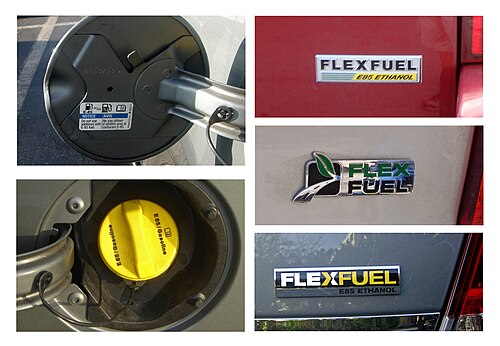
Typical labeling used in the US to identify E85 vehicles. Top left: a small sticker in the back of the fuel filler door. Bottom left: the bright yellow gas cap used in newer models. E85 Flexfuel badging used in newer models from Chrysler (top right), Ford (middle right) and GM (bottom right).

E85 fuel sold at a regular gasoline station.