History of painting
Videos
The history of painting reaches back in time to artifacts and artwork created by pre-historic artists, and spans all cultures. It represents a continuous, though periodically disrupted, tradition from

Lubang Jeriji Saléh cave, in Kalimantan, Indonesia, contains one of the oldest known figurative paintings, a 40,000-year-old depiction of a bull.
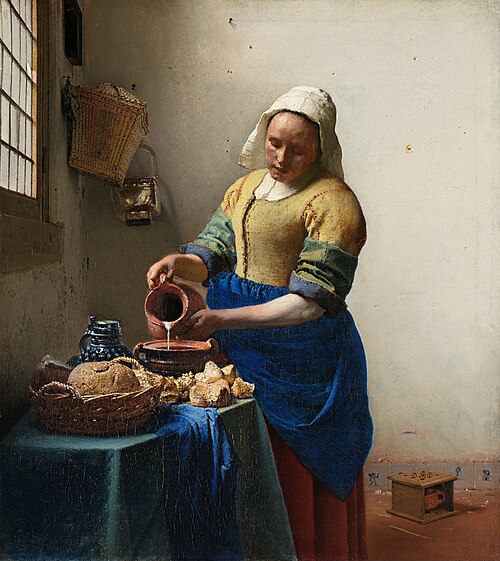
The Milkmaid by Johannes Vermeer, c. 1657

Cave paintings depicting a wild boar hunt in the Maros-Pangkep karst of Sulawesi are estimated to be at least 43,900 years old (2014). This finding was recognized as "the oldest known depiction of storytelling and the earliest instance of figurative art in human history."

In 2021, researchers discovered ancient cave art in Leang Tedongnge, Sulawesi, Indonesia, estimated to be at least 45,500 years old. Depicting a warty pig, this artwork is recognized as the world's oldest known example of figurative or representational art.
Medieval art
Videos
The medieval art of the Western world covers a vast scope of time and place, with over 1000 years of art in Europe, and at certain periods in Western Asia and Northern Africa. It includes major art mo
History of painting
…Panel painting becomes more common during the Romanesque period, under the heavy influence of Byzantine icons. Towards the middle of the 13th century, Medieval art and Gothic painting became more realistic, with the beginnings of interest in the depiction of volume and perspective in Italy with Cimabue and then…
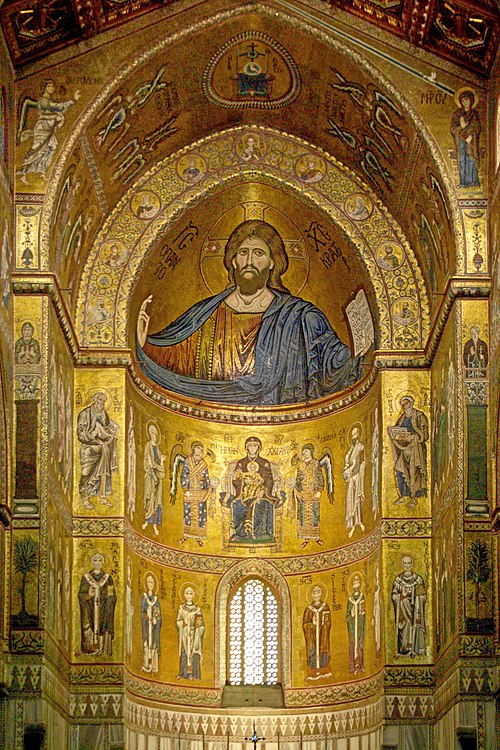
Byzantine Church mosaics, Monreale, Sicily, late 12th century

Detail of The Effects of Good Government, a fresco in the City Hall of Siena by Ambrogio Lorenzetti, 1338.
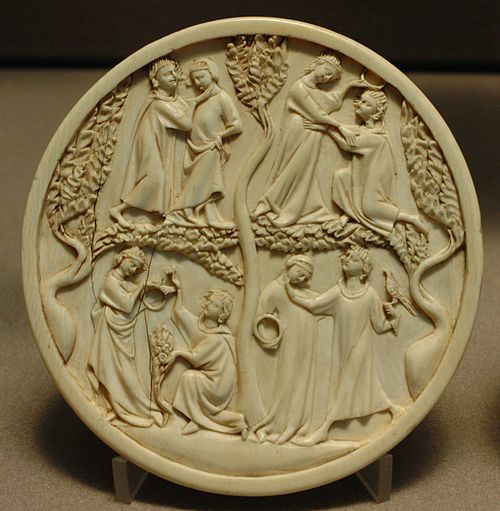
Scenes of courtly love on a lady's ivory mirror-case. Paris, 1300–1330.

The jewelled cover of the Codex Aureus of St. Emmeram, c. 870, a Carolingian Gospel book.