History of supernova observation
Videos
Photos
The known history of supernova observation goes back to 1006 AD. All earlier proposals for supernova observations are speculations with many alternatives.

The Crab Nebula is a pulsar wind nebula associated with the 1054 supernova.
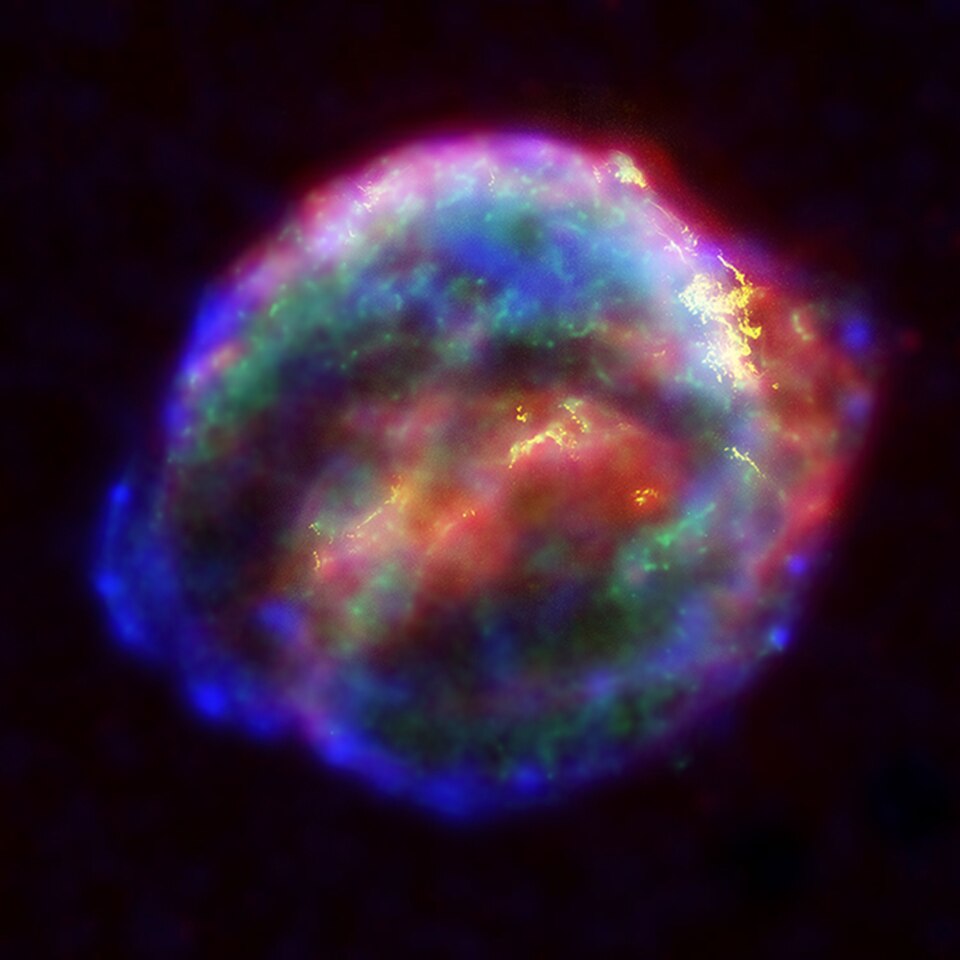
Multiwavelength X-ray image of the remnant of Kepler's Supernova, SN 1604. (Chandra X-ray Observatory)

Supernova 1987A remnant near the center

In 1999 a star within IC 755 was seen to explode as a supernova and named SN 1999an.
SN 185
Videos
Photos
SN 185 was a transient astronomical event observed in the year AD 185, likely a supernova. The transient occurred in the direction of Alpha Centauri, between the constellations Circinus and Centaurus, centered at RA 14h 43m Dec −62° 30′, in Circinus. This "guest star" was observed by Chinese astronomers in the Book of Later Han (后汉书), and might have been recorded in Roman literature. It remained visible in the night sky for eight months. This is believed to be the first supernova for which records exist.

Infrared images from NASA's Spitzer Space Telescope and WISE are combined with X-ray data from the Chandra X-ray Observatory and ESA's XMM-Newton Observatory in this image of RCW 86.

The SMARTS 0.9-meter Telescope has captured an echo of the past in this image. RCW 86 is a literal shell of its former self, the gaseous remnant of a supernova.