History of the Byzantine Empire
Videos
Photos
The Byzantine Empire's history is generally periodised from late antiquity until the Fall of Constantinople in 1453 AD. From the 3rd to 6th centuries, the Greek East and Latin West of the Roman Empire gradually diverged, marked by Diocletian's formal partition of its administration in 285, the establishment of an eastern capital in Constantinople by Constantine I in 330, and the adoption of Christianity as the state religion under Theodosius I, with others such as Roman polytheism being proscribed. Under the reign of Heraclius, the Empire's military and administration were restructured and adopted Greek for official use instead of Latin. While there was an unbroken continuity in administration and other features of Roman society, historians have often distinguished the Byzantine epoch from earlier eras in Roman history for reasons including the imperial seat moving from Rome to Constantinople and the predominance of Greek instead of Latin.

The Baptism of Constantine, painted by pupils of Raphael (1520–1524, fresco, Vatican City, Apostolic Palace). Eusebius of Caesaria records that Constantine delayed receiving baptism until shortly before his death, as was customary among Christian converts at the time.

Leo I of the Byzantine Empire (401–474, reigned 457–474)

Justinian depicted on one of the famous mosaics of the Basilica of San Vitale, Ravenna.

Theodora with her retinue (mosaic from Basilica of San Vitale, Ravenna). Justinian's influential wife was a former mime actress, whose earlier life is vividly described by Procopius in Secret History.
Late antiquity
Videos
Photos
Late antiquity is sometimes defined as spanning from the end of classical antiquity to the local start of the Middle Ages, from around the late 3rd century up to the 7th or 8th century in Europe and adjacent areas bordering the Mediterranean Basin depending on location. The popularisation of this periodization in English has generally been credited to historian Peter Brown, who proposed a period between 150–750 AD. The Oxford Centre for Late Antiquity defines it as "the period between approximately 250 and 750 AD". Precise boundaries for the period are a continuing matter of debate. In the West, its end was earlier, with the start of the Early Middle Ages typically placed in the 6th century, or even earlier on the edges of the Western Roman Empire.
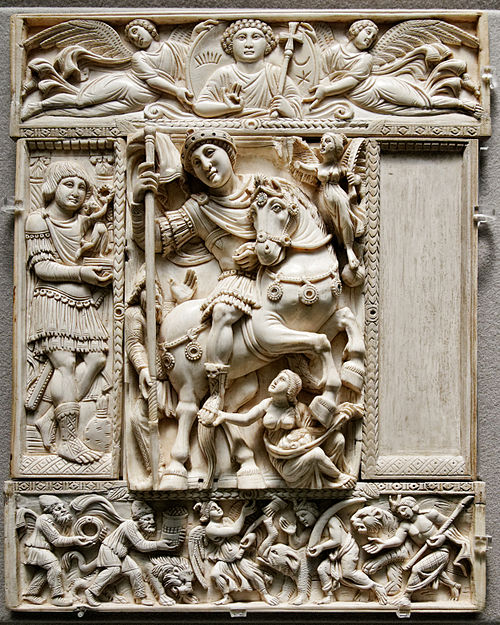
The Barberini ivory, a late Leonid/Justinian Byzantine ivory leaf from an imperial diptych, from an imperial workshop in Constantinople in the first half of the sixth century (Louvre Museum)
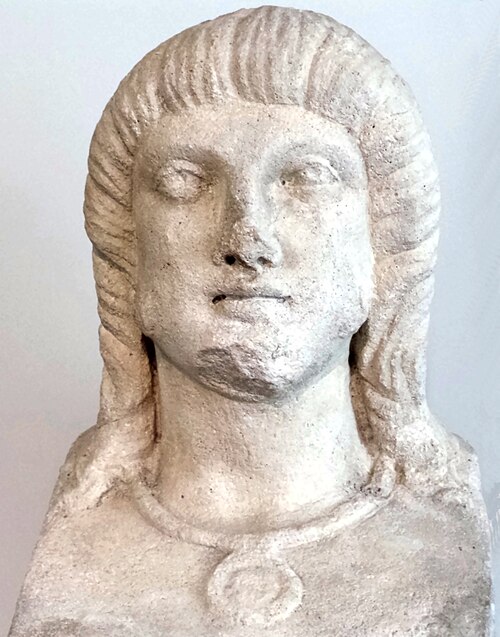
Late 4th-century Roman bust of a Germanic slave in Augusta Treverorum (Trier) in Belgica Prima, seat of the praetorian prefecture of Gaul (Rheinisches Landesmuseum Trier)

Modern statue of Constantine I at York, where he was proclaimed Augustus in 306

The Favourites of the Emperor Honorius, 1883: John William Waterhouse expresses the sense of moral decadence that coloured the 19th-century historical view of the 5th century.