The history of the Republic of China began in 1912 with the end of the Qing dynasty, when the Xinhai Revolution and the formation of the Republic of China put an end to 2,000 years of imperial rule. The Republic experienced many trials and tribulations after its founding which included being dominated by elements as disparate as warlord generals and foreign powers.

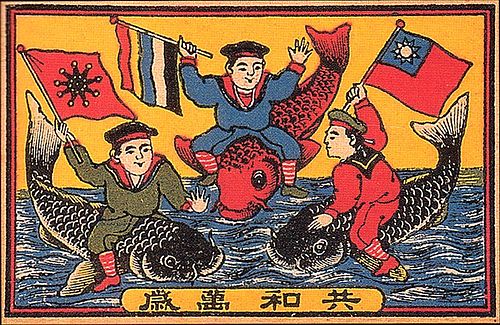
Three different flags were originally used during the Revolution. The bottom message says Long live the Republic! with the five races represented by the Five-Color Flag of the Republic.

Bonds that Sun Yat-sen used to raise money for revolutionary cause. The Republic of China was also once known as the Chunghwa Republic.

A calendar that commemorates the first year of the Republic as well as the election of Sun Yat-sen as the provisional President.
The Three Principles of the People is a political philosophy developed by Sun Yat-sen as part of a philosophy to improve China made during the Republican Era. The three principles are often translated into and summarized as nationalism, democracy, and the livelihood of the people. This philosophy has been claimed as the cornerstone of the nation's policy as carried by the Kuomintang; the principles also appear in the first line of the national anthem of the Republic of China.

A sign on Dadan Island near Quemoy (Kinmen) facing Mainland China proclaiming "A Unified China Under Tridemism" set by General Zhao in Aug. 1986, dismissed after 1987 Lieyu Massacre