The history of the University of Florida is firmly tied to the history of public education in the state of Florida. The University of Florida originated as several distinct institutions that were cons

An artist's rendering of the University of Florida's Gainesville campus in 1916, looking from the northeast.

Buckman Hall was completed in 1906, and is currently used as a residence hall. It was named for state representative Henry Holland Buckman, the principal author of the Buckman Act, which consolidated Florida's public institutions of higher education in 1905.

Andrew Sledd, the first president of the University of Florida (1905–1909). During his presidency, the university was officially known as the "University of the State of Florida"
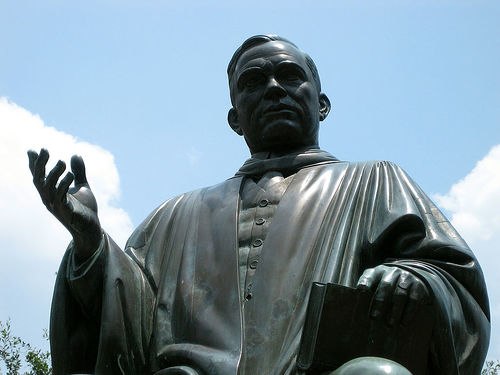
Campus statue of Albert A. Murphree, the second president of the University of Florida (1909–1927). Murphree organized many of the university's constituent colleges and schools.
East Florida Seminary
Videos
The East Florida Seminary was an institution of higher learning established by the State of Florida in 1853, and absorbed into the newly established University of Florida in 1905. The school operated
History of the University of Florida
…distinct institutions that were consolidated to create a single state-supported university by the Buckman Act of 1905. The oldest of these was the East Florida Seminary, one of two seminaries of higher learning established by the Florida Legislature. The East Florida Seminary opened in Ocala 1853, becoming the first…

East Florida Seminary in 1891. Epworth Hall is on the left, with the dormitory in the middle and right

Wooden barracks or dormitory building for the East Florida Seminary