History of the Uyghur people
The history of the Uyghur people extends over more than two millennia and can be divided into four distinct phases: Pre-Imperial, Imperial, Idiqut, and Mongol, with perhaps a fifth modern phase running from the death of the Silk Road in AD 1600 until the present.
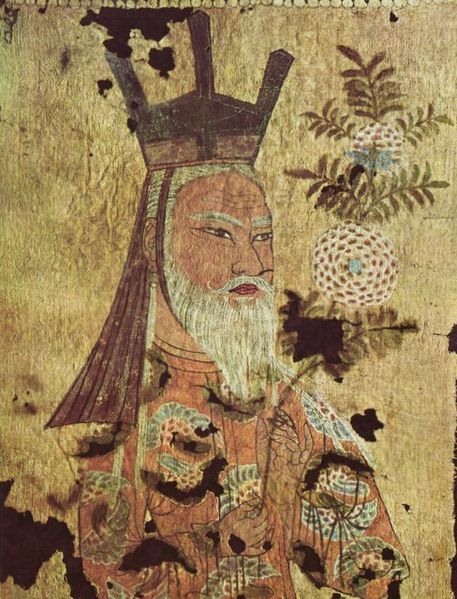
An 8th-century Uyghur Khagan
Uyghur Khanate in geopolitical context, c. AD 800
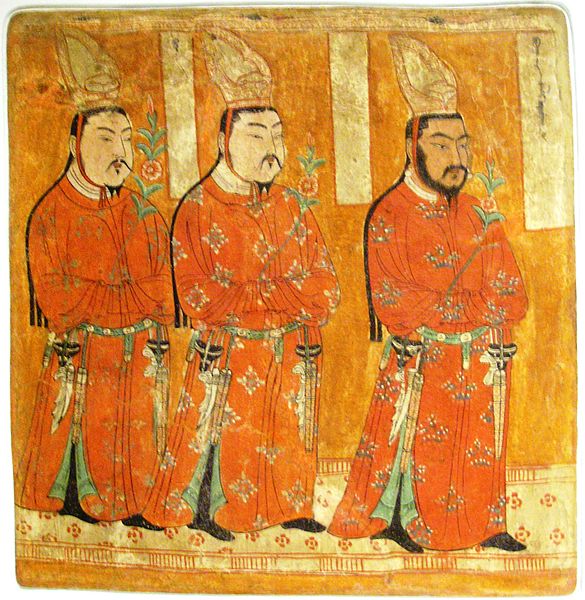
Uyghur princes wearing robes and headgear. Bezeklik, Cave 9
Uyghur princesses, Bezeklik, Cave 9, wall painting, ca. 9th/10th century AD
The Uyghur Khaganate was a Turkic empire that existed for about a century between the mid 8th and 9th centuries. It was a tribal confederation under the Orkhon Uyghur (回鶻) nobility, referred to by the Chinese as the Jiu Xing, a calque of the name Toquz Oghuz or Toquz Tughluq.
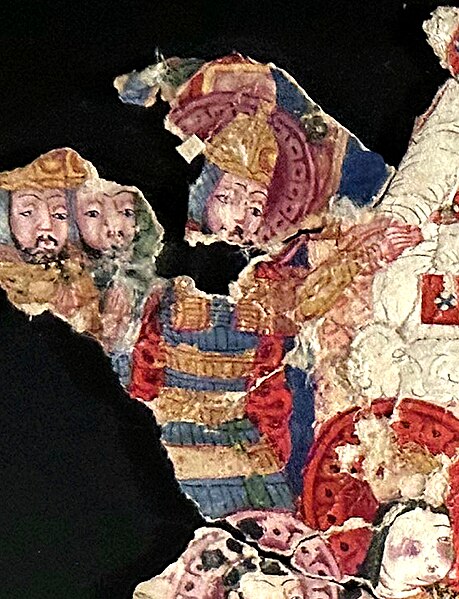
Bögü Qaghan, third Khagan of the Uyghurs, in a suit of armour, converting to Manicheism in 762. 8th century manuscript (MIK III 4979).
Uyghur princesses from the Bezeklik murals.
Uyghur princes wearing Chinese-styled robes and headgear. Bezeklik, Cave 9, 9–12th century CE.
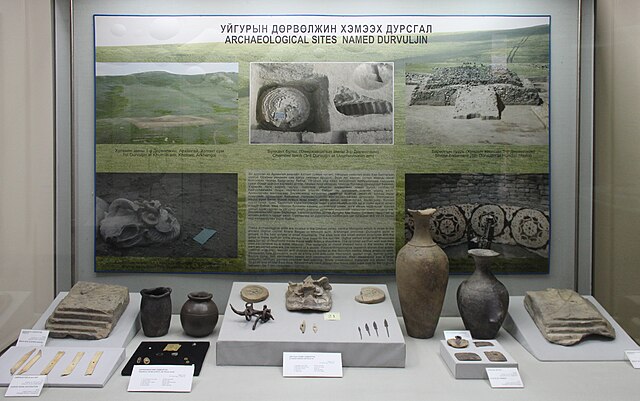
Uyghur Khaganate "Durvuljin" tombs, near the Uyghur capital of Khara Balgas, 7th–9th century CE. Orkhon Valley. National Museum of Mongolia