History of the metric system
Videos
The history of the metric system began during the Age of Enlightenment with measures of length and weight derived from nature, along with their decimal multiples and fractions. The system became the s
James Watt, British inventor and advocate of an international decimalised system of measure


The north and south sections of the meridional survey met at Rodez cathedral, seen here dominating the Rodez skyline

The Paris meridian which passes through the Paris Observatory (Observatoire de Paris). The metre was defined along this meridian using a survey that stretched from Dunkirk to Barcelona.

U.S. national prototype of the metre, showing the bar number (#27), the Tresca cross-section and one of the lines
The International System of Units, internationally known by the abbreviation SI, is the modern form of the metric system and the world's most widely used system of measurement. It is the only system o
History of the metric system
…international body Conférence générale des poids et mesures or CGPM to oversee systems of weights and measures based on them. In 1960, the CGPM launched the International System of Units (in French the Système international d'unités or SI) with six "base units": the metre, kilogram, second, ampere, degree Kelvin (subsequently renamed…
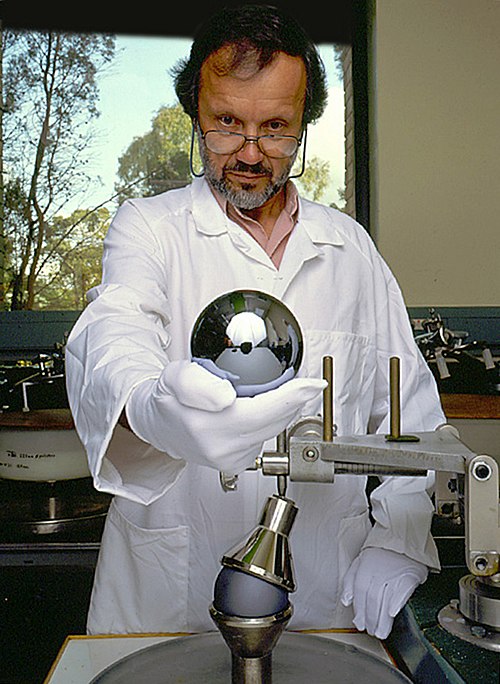
Silicon sphere for the Avogadro project used for measuring the Avogadro constant to a relative standard uncertainty of 2×10⁻⁸ or less, held by Achim Leistner

Stone marking the Austro-Hungarian/Italian border at Pontebba displaying myriametres, a unit of 10 km used in Central Europe in the 19th century (but since deprecated)