House of de Vere
Videos
The House of de Vere was an old and powerful English aristocratic family who derived their name from Ver, in Lower Normandy, France.

Hedingham Castle – the de Vere family seat. The Norman keep is all that remains of the castle in Essex where most of the land was concentrated.

Susan de Vere, 4th Countess of Pembroke seated with her family, painted by Anthony van Dyck.

Diana Cecil, 18th Countess of Oxford, painted by William Larkin.

Diana de Vere, 1st Duchess of St Albans, her husband was the son of King Charles II of England, painted by Godfrey Kneller.
Edward de Vere, 17th Earl of Oxford, was an English peer and courtier of the Elizabethan era. Oxford was heir to the second oldest earldom in the kingdom, a court favourite for a time, a sought-after
House of de Vere
…John de Vere, 16th Earl of Oxford (1516–1562), retained a company of players, known as Oxford's Men from 1547 until his death Edward de Vere, 17th Earl of Oxford (1550–1604), patron of the arts, noted poet and playwright, one of Elizabeth’s great favourites. Oxfordians believe him to be the writer of at least…
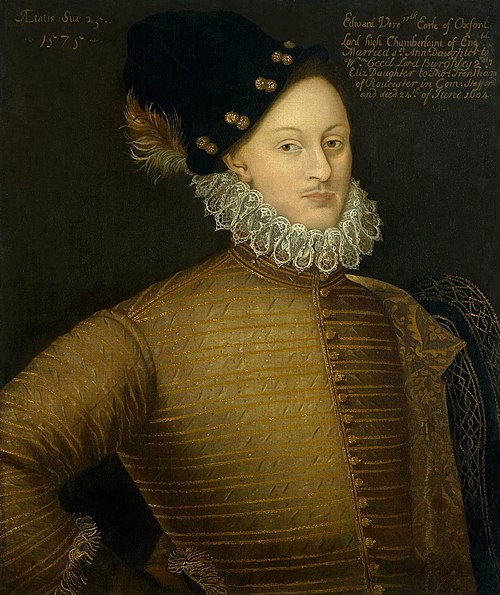
17th-century portrait based on lost 1575 original, National Portrait Gallery, London

The surviving keep of Hedingham Castle, the de Vere family seat since the Norman Conquest

William Cecil, 1st Baron Burghley, the Queen's Secretary of State and de Vere's father-in-law, c. 1571.

Coat of Arms of Edward de Vere from George Baker's The composition or making of the moste excellent and pretious oil called oleum magistrale (1574)