Human evolution
Videos
Homo sapiens is a distinct species of the hominid family of primates, which includes all the great apes. Over their evolutionary history, humans gradually developed traits such as bipedalism, dexterit

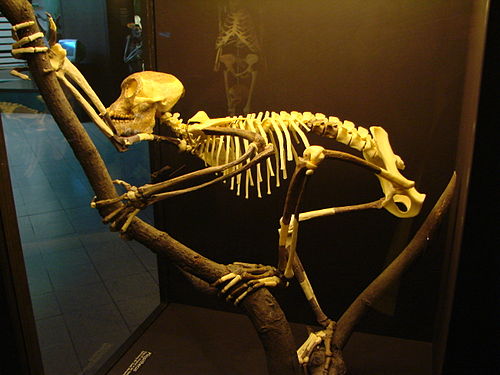
Notharctus tenebrosus, American Museum of Natural History, New York
Reconstructed tailless Proconsul skeleton

Genetic data suggest that chimpanzees and humans may have diverged from a common ancestor between 9 and 7 million years ago.

Chimpanzee nest. Later hominins may have developed niche creating shelter-building traditions from such earlier nest-building practices.
Homo
Videos
Homo is a genus of great ape that emerged from the early hominin genus Australopithecus, encompassing a single extant species, Homo sapiens, along with a number of extinct species classified as either
Reconstruction of Australopithecus afarensis, Natural History Museum, Vienna


Reconstruction of H. ergaster, American Museum of Natural History

Homo heidelbergensis may have evolved from H. ergaster, possibly following an intense population bottleneck 800,000 to 900,000 years ago.

Teilhardina DB15