Huna people
Videos
Hunas, Huna or Hun was the name given by the ancient Indians to a group of Central Asian tribes who, via the Khyber Pass, entered the Indian subcontinent at the end of the 5th or early 6th century. Th

Hephthalite horseman on British Museum bowl, 460–479 CE. According to Procopius of Caesarea, they were of the same stock as European Huns "in fact as well as in name", but sedentary and white-skinned.

Gurjara-Pratihara coinage of Mihira Bhoja, King of Kanauj.

Victory pillar of Yashodharman at Sondani, Mandsaur claiming victory over the Huns.
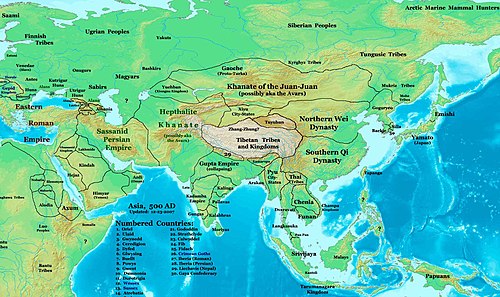
Asia in 500 CE, showing the Huna domain at its greatest extent.
Gupta Empire
Videos
The Gupta Empire was an Indian empire during the classical period of the Indian subcontinent which existed from the mid 3rd century to mid 6th century CE. At its peak, the dynasty ruled over an empire
Huna people
…the Indian subcontinent at the end of the 5th or early 6th century. The Hunas occupied areas as far south as Eran and Kosambi, greatly weakening the Gupta Empire. The Hunas were ultimately defeated by a coalition of Indian princes that included an Indian king Yasodharman and the Gupta emperor, Narasimhagupta…

Queen Kumaradevi and King Chandragupta I, depicted on a gold coin

Standing Buddha in red sandstone, Art of Mathura, Gupta period c. 5th century CE. Mathura Museum

Gold coins of Chandragupta II

Sculpture of Vishnu (red sandstone), 5th century CE.