Hungarian volunteers in the Winter War
The Hungarian Volunteers in the Winter War travelled to fight for the Finns after the Soviet invasion of Finland in 1939. For a variety of reasons, volunteers from the Kingdom of Hungary fought on the side of Finland during the Winter War (1939–1940) against the Soviet Union.
Statue of Count Pál Teleki, who organized the Hungarian support of Finland during the Winter War, in Balatonboglár, Hungary.
Kingdom of Hungary (1920–1946)
The Kingdom of Hungary, referred to retrospectively as the Regency and the Horthy era, existed as a country from 1920 to 1946 under the rule of Miklós Horthy, Regent of Hungary, who officially represented the Hungarian monarchy. In reality there was no king, and attempts by King Charles IV to return to the throne shortly before his death were prevented by Horthy. Hungary under Horthy was characterized by its conservative, nationalist, and fiercely anti-communist character. The government was based on an unstable alliance of conservatives and right-wingers. Foreign policy was characterized by revisionism — the total or partial revision of the Treaty of Trianon, which had seen Hungary lose over 70% of its historic territory along with over three million Hungarians, who mostly lived in the border territories outside the new borders of the kingdom, in the Kingdom of Romania and the newly created states of Czechoslovakia and the Kingdom of Serbs, Croats and Slovenes. Republican Austria, the successor of the former other half of the dual monarchy also received some minor territory from Hungary. Thus the post-1918 Kingdom can be described as a rump state. Hungary's interwar politics were dominated by a focus on the territorial losses suffered from this treaty, with the resentment continuing until the present.
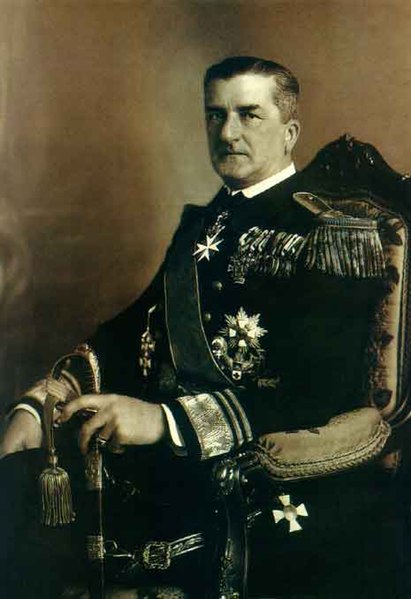
Miklós Horthy, Regent of Hungary
István Bethlen, Prime Minister of Hungary.
Hungarian armor and infantry in retreat, August 1944


