Hunger in the United States
Videos
Hunger in the United States of America affects millions of Americans, including some who are middle class, or who are in households where all adults are in work. The United States produces far more food than it needs for domestic consumption—hunger within the U.S. is caused by some Americans having insufficient money to buy food for themselves or their families. Additional causes of hunger and food insecurity include neighborhood deprivation and agricultural policy. Hunger is addressed by a mix of public and private food aid provision. Public interventions include changes to agricultural policy, the construction of supermarkets in underserved neighborhoods, investment in transportation infrastructure, and the development of community gardens. Private aid is provided by food pantries, soup kitchens, food banks, and food rescue organizations.

Members of the United States Navy serving hungry Americans at a soup kitchen in Red Bank, New Jersey, during a 2011 community service project

Volunteers preparing meals for Meals on Wheels recipients

The U.S. Department of Agriculture sets up a food packing facility to send food to rural students effected by the COVID-19 school closures.

A small group of people planting fruits or vegetables in a communal garden
Poverty in the United States
Videos
In the United States, poverty has both social and political implications. In 2020, there were 37.2 million people in poverty. Some of the many causes include income inequality, inflation, unemployment, debt traps and poor education. The majority of adults living in poverty are employed and have at least a high school education. Although the US is a relatively wealthy country by international standards, it has a persistently high poverty rate compared to other developed countries due in part to a less generous welfare system.

Tents of the homeless in San Francisco, California, May 2020

Rally Poor Peoples Campaign Washington DC

The "Basic Seven", a food plan developed by the United States Department of Agriculture.
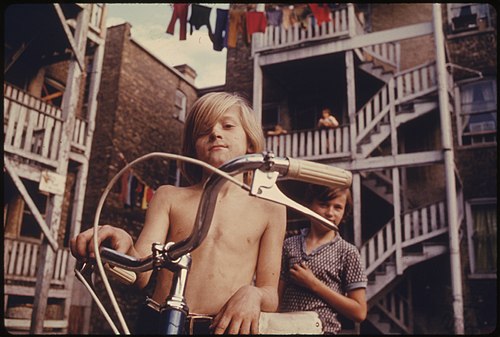
A neighborhood of poor white people, Chicago, 1974