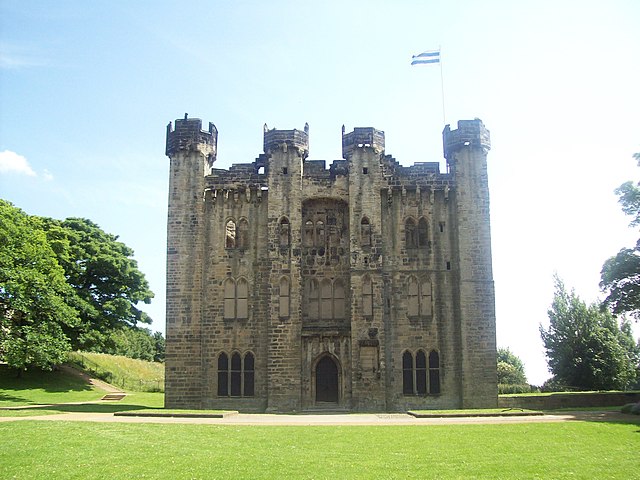
Hylton Castle is a stone castle in the North Hylton area of Sunderland, Tyne and Wear, England. Originally built from wood by the Hilton family shortly after the Norman Conquest in 1066, it was later rebuilt in stone in the late 14th to early 15th century. The castle underwent major changes to its interior and exterior in the 18th century and it remained the principal seat of the Hylton family until the death of the last Baron in 1746. It was then Gothicised but neglected until 1812, when it was revitalised by a new owner. Standing empty again until the 1840s, it was briefly used as a school until it was purchased again in 1862. The site passed to a local coal company in the early 20th century and was taken over by the state in 1950.
West façade of Hylton Castle, 2023
Hylton Castle and St Catherine's Chapel (on the left) – unknown artist, c. 1800
Interior of castle, 2006
St Catherine's chapel.
Baron Hylton is a title that has been created twice, once in the Peerage of England and once in the Peerage of the United Kingdom. The first creation came in the Peerage of England 1295 when Robert Hylton was summoned to the Model Parliament as Lord Hylton by writ. His son, Alexander, was called to Parliament in 1332 and 1335, but no further summons were sent for his descendants. Therefore, the title has only been held de jure after the death of the second baron. Indeed, the last baron was Member of Parliament for Carlisle after "inheriting" the title, due to this anomaly. Despite this, the creation is deemed to have fallen into abeyance on the death of the eighteenth baron without male heirs in 1746.
Hylton Castle, the seat of the Hylton family