Hyperinflation
Videos
In economics, hyperinflation is a very high and typically accelerating inflation. It quickly erodes the real value of the local currency, as the prices of all goods increase. This causes people to min

100 quintillion (1020) pengő, the largest denomination bill ever issued, Hungary, 1946. 1 sextillion pengő notes were printed but never issued.

The price of gold in Germany, 1 January 1918 – 30 November 1923. (The vertical scale is logarithmic.)
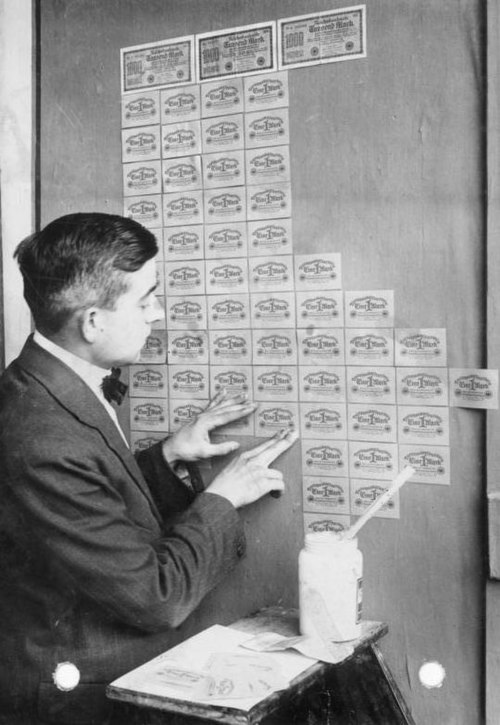
Germany, 1923: banknotes had lost so much value that they were used as wallpaper.
Hungarian pengő
Videos
The pengő was the currency of Hungary between 1 January 1927, when it replaced the korona, and 31 July 1946, when it was replaced by the forint. The pengő was subdivided into 100 fillér. Although the
Hyperinflation
…The largest denomination banknote ever officially issued for circulation was in 1946 by the Hungarian National Bank for the amount of 100 quintillion pengő (1020; 100,000,000,000,000,000,000; 100 million million million). (A banknote worth 10 times as much, 1021 (1 sextillion) pengő, was printed but not…

2 pengő, 1936

10 P, 1929

10 million mil.-P, 1946