Iconostasis
Videos
In Eastern Christianity, an iconostasis is a wall of icons and religious paintings, separating the nave from the sanctuary in a church. Iconostasis also refers to a portable icon stand that can be pla
Five-panel Deesis row (center), iconostasis in the Cathedral of the Annunciation in the Moscow Kremlin by Theophanes the Greek, 1405


People's Salvation Cathedral in Bucharest (the world's largest Orthodox iconostasis)

The Temple of Saint Sava in Belgrade
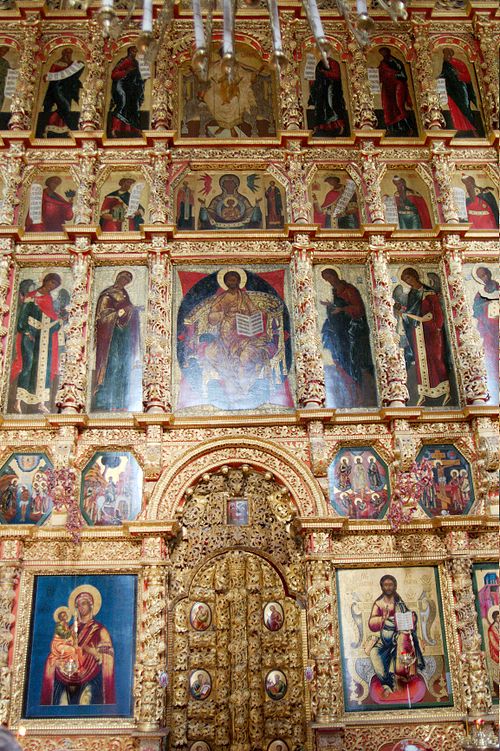
Mid-17th-century iconostasis at Ipatiev Monastery. To either side of the Holy Doors are Christ Pantokrator and the Theotokos; above them, the Great Feasts; above them, the Deesis; above that Prophets to either side of Our Lady of the Sign; above them the Apostles to either side of the Holy Trinity.
Altar
Videos
An altar is a table or platform for the presentation of religious offerings, for sacrifices, or for other ritualistic purposes. Altars are found at shrines, temples, churches, and other places of wors

Altar in Roskilde Lutheran Cathedral beneath a carved reredos

Reconstruction of a horned altar at Tel Be'er Sheva, Israel.

Ancient Greek kylix showing a hoplite offering a sacrifice before an altar, around 480 BC. Ancient Agora Museum of Athens in the Stoa of Attalus

The ancient Altar of Pergamon, reconstructed at the Pergamon museum, Berlin.