Ikebana
Videos
Ikebana is the Japanese art of flower arrangement. It is also known as kadō. The origin of ikebana can be traced back to the ancient Japanese custom of erecting evergreen trees and decorating them wit
Shōka arrangement by the 40th headmaster Ikenobō Senjō, drawing from the Sōka Hyakki by the Shijō school, 1820


Ikebana flower arrangement in a tokonoma (alcove), in front of a kakemono (hanging scroll)

A drawing of mitsu-gusoku, from the Senden-shō (15th–18th century)

Illustration from the Kaō irai no Kadensho, believed to be the oldest extant manuscript of ikebana teaching, dating from a time shortly after that of Ikenobō Senkei. It shows various arranging styles of tatebana (ogibana) wide-mouth (right) and upright styles.
Yorishiro
Videos
A yorishiro in Shinto terminology is an object capable of attracting spirits called kami, thus giving them a physical space to occupy during religious ceremonies. Yorishiro are used during ceremonies
Ikebana
…of flowers'). The origin of ikebana can be traced back to the ancient Japanese custom of erecting evergreen trees and decorating them with flowers as Yorishiro to invite the gods. Later, flower arrangements were instead used to adorn the tokonoma (alcove) of a traditional Japanese home…

A classic yorishiro: a giant tree, or shinboku
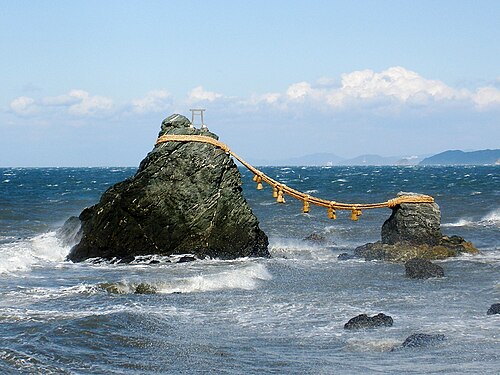
Two iwakura: Meoto Iwa, the Husband-and-Wife Rocks

A maneki-neko is supposed to attract the kami of luck.