Imperial Japanese Navy
Videos
The Imperial Japanese Navy was the navy of the Empire of Japan from 1868 to 1945, when it was dissolved following Japan's surrender in World War II. The Japan Maritime Self-Defense Force was formed be

The Battle of Dan-no-ura in 1185

The warship of Yamada Nagamasa (1590–1630), a merchant and soldier who traveled to Ayutthaya (Thailand)

No. 6 Odaiba battery, one of the original Edo-era battery islands. These batteries are defensive structures built to withstand naval intrusions.
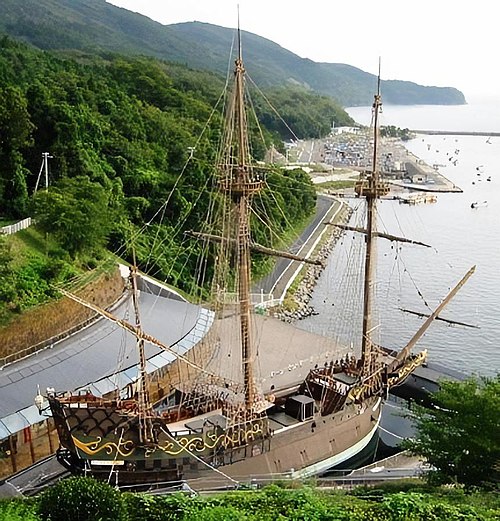
Replica of the Japanese-built 1613 galleon San Juan Bautista, in Ishinomaki
Japanese battleship Yamato
Videos
Yamato was the lead ship of her class of battleships built for the Imperial Japanese Navy shortly before World War II. She and her sister ship, Musashi, were the heaviest and most powerfully armed bat
Imperial Japanese Navy
…quantitative deficiencies compared to the United States. While the primary focus of Circle Three was to be the construction of two super-battleships, Yamato and Musashi, it also called for building the two Shōkaku-class aircraft carriers, along with sixty-four other warships of other categories. Circle Three…

Yamato undertaking sea trials in the Bungo Channel, 20 October 1941

Yamato near the end of her fitting out, 20 September 1941

Yamato during sea trials, October 1941

Admiral Isoroku Yamamoto (fourth from left) and his staff posing with the Yamato's 46 cm (18.1 in) gun turret 3 on 20 December 1941