Incendiary device
Videos
Incendiary weapons, incendiary devices, incendiary munitions, or incendiary bombs are weapons designed to start fires. They may destroy structures or sensitive equipment using fire, and sometimes oper
Loading a Mark 77 napalm bomb onto a US Marine Strike Fighter Squadron F/A-18A Hornet aircraft during a June 1993 training exercise


A 17th century fire or light ball from Veste Coburg, Germany

An incendiary bomb dropped on Southend-on-Sea in 1916

Remains of a metal canister from a thermite incendiary bomb dropped by a Zeppelin on London during World War I
Greek fire
Videos
Greek fire was an incendiary weapon used by the Byzantine Empire from the seventh to the fourteenth centuries. The recipe for Greek fire was a closely-guarded state secret and has been lost to history
Incendiary device
…fat and other similar compounds. Substances such as quicklime and sulfur could be toxic and blinding. Incendiary mixtures, such as the petroleum-based Greek fire, were launched by throwing machines or administered through a siphon. Sulfur- and oil-soaked materials were sometimes ignited and thrown at the enemy…
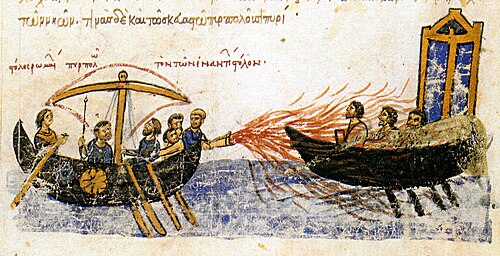
"The Roman fleet burns the opposite fleet down" – An Eastern Roman / Byzantine warship using their "secret weapon" Greek fire against a ship belonging to the rebel Thomas the Slav, AD 821. (12th century illustration from the "Madrid Skylitzes").

Use of a cheirosiphōn ("hand-siphōn"), a portable flamethrower, used from a flying bridge against a castle. Illumination from the Poliorcetica of Hero of Byzantium.

Proposed reconstruction of the Greek fire mechanism by Haldon and Byrne

Detail of a cheirosiphōn