Independence of Brazil
Videos
The independence of Brazil comprised a series of political and military events that led to the independence of the Kingdom of Brazil from the United Kingdom of Portugal, Brazil and the Algarves as the Brazilian Empire. It is celebrated on 7 September, the date when prince regent Pedro of Braganza declared the country's independence from the United Kingdom of Portugal, Brazil and the Algarves on the banks of the Ipiranga brook in 1822 on what became known as the Cry of Ipiranga. Formal recognition by Portugal came with the Treaty of Rio de Janeiro, signed in 1825.

Painting Independence or Death, by Pedro Américo, depicting the Cry of Ipiranga on 7 September 1822, with prince Pedro's Guard of Honor greeting him in support while some discard blue and white armbands that represented loyalty to Portugal.

Landing of Pedro Álvares Cabral in Brazil, South America, 1500.

Acclamation ceremony of King John VI of the new United Kingdom of Portugal, Brazil and the Algarves in the Paço Real in Rio de Janeiro, temporary capital, Brazil, 6 February 1818.

The Portuguese Cortes
Pedro I of Brazil
Videos
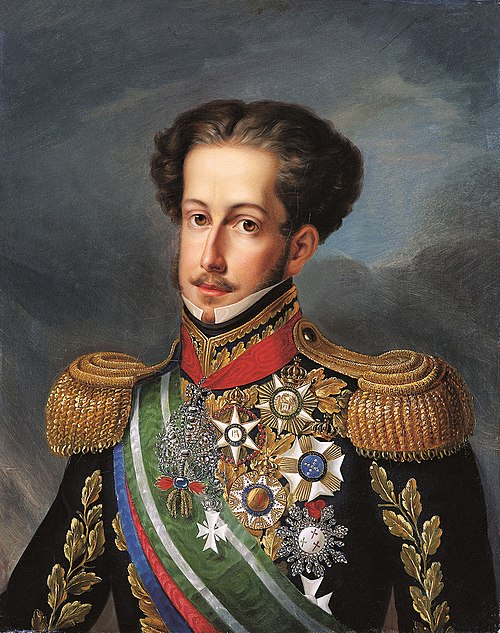
Dom Pedro I was the founder and first ruler of the Empire of Brazil, where he was known as "the Liberator". As King Dom Pedro IV, he reigned briefly over Portugal, where he also became known as "the Liberator" as well as "the Soldier King". Born in Lisbon, Pedro I was the fourth child of King Dom John VI of Portugal and Queen Carlota Joaquina, and thus a member of the House of Braganza. When the country was invaded by French troops in 1807, he and his family fled to Portugal's largest and wealthiest colony, Brazil.
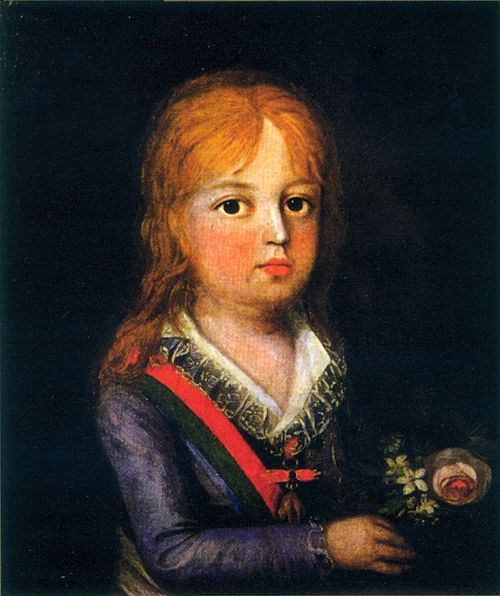
Pedro around age 2, c.1800, by Agustín Esteve
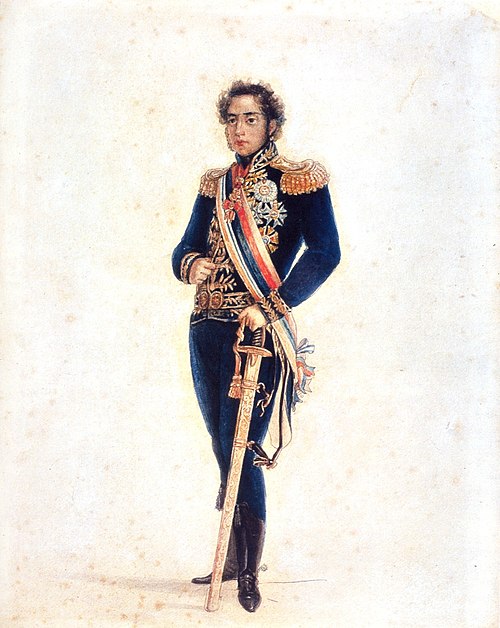
Portrait by Jean-Baptiste Debret of Pedro around age 18, c.1816

Pedro, in his father's name, makes an oath of obedience to the Portuguese Constitution on 26 February 1821. He can be seen at the middle of the balcony raising his hat. Painting by Félix Taunay, Baron of Taunay.