India–Pakistan relations
Videos
India and Pakistan have a complex and largely hostile relationship that is rooted in a multitude of historical and political events, most notably the partition of British India in August 1947.

Jinnah and Gandhi engaged in a heated conversation. A well-known photograph recently attributed to Kulwant Roy.

A refugee special train at Ambala Station during the partition of India
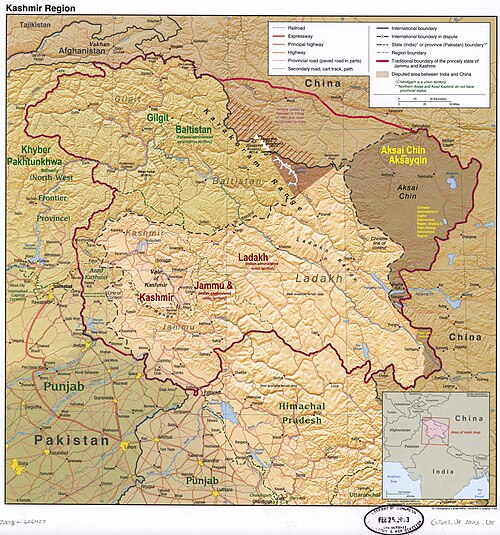
India claims the entire erstwhile British Indian princely state of Jammu and Kashmir based on an instrument of accession signed in 1947.

Pakistan's Lt Gen Niazi (sitting second from right) signing the Instrument of Surrender, following the defeat of Pakistan in the India–Pakistan war of 1971.
Radcliffe Line
Videos
The Radcliffe Line was the boundary demarcated by the two boundary commissions for the provinces of Punjab and Bengal during the Partition of India. It is named after Cyril Radcliffe, who, as the join
India–Pakistan relations
…toll estimated to have reached between several hundred thousand and one million people as Hindus and Muslims migrated in opposite directions across the Radcliffe Line to reach India and Pakistan, respectively. In 1950, India emerged as a secular republic with a Hindu-majority population. Shortly afterwards, in 1956…

Districts of Punjab with Muslim (green) and non-Muslim (pink) majorities, as per 1941 census