India–Russia relations
Videos
The Republic of India and the Russian Federation established bilateral relations in 1991 and remain close allies. Previously, during the Cold War, Indian–Soviet relations were considered a "strong str

Prime Minister of India Narendra Modi and President of Russia Vladimir Putin in Moscow, Russia, 9 July 2024

Soviet Ambassador Kirill Novikov arriving in New Delhi 1947 to establish formal diplomatic relations with India

Soviet-Indian postage stamp

Former prime minister Atal Bihari Vajpayee with Russia's president Vladimir Putin in October 2000.
Foreign relations of India
Videos
India, officially the Republic of India, has full diplomatic relations with 201 states, including Palestine, the Holy See, Niue and the Cook Islands. The Ministry of External Affairs is the government
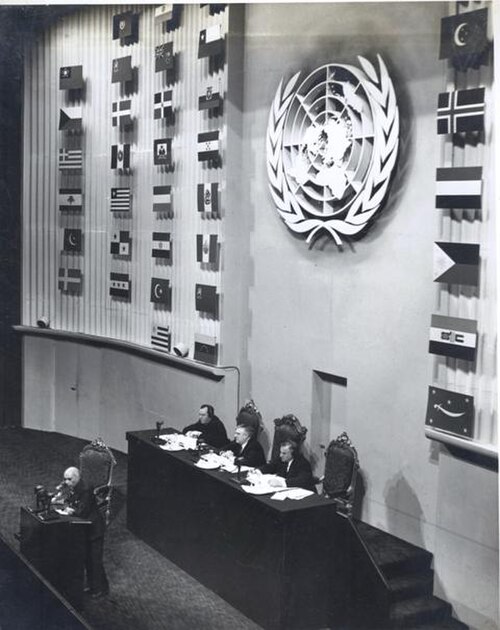
Jawaharlal Nehru, the 1st Prime Minister of India, addressing the United Nations (1948)

Pranab Mukherjee, the former Finance Minister of India and former President of India with former US President George W. Bush in 2008.

Indian External Affairs Minister Dr. S. Jaishankar meeting US Secretary of Defense Lloyd Austin at the Pentagon, 29 September 2023.

The Prime Minister, Dr. Manmohan Singh at the opening ceremony of third Summit of the Bay of Bengal Initiative for Multi-Sectoral Technical and Economic Cooperation (BIMSTEC), at Nay Pyi Taw, Myanmar on 4 March 2014