Indigenous peoples in Colombia, also known as Native Colombians, are the Indigenous peoples of the Americas whose ancestors lived in Colombia before the 16th-century Spanish colonization of Colombia.

The zipa used to cover his body in gold and, from his Muisca raft, he offered treasures to the Guatavita goddess in the middle of the sacred lake. This old Muisca tradition became the origin of the El Dorado legend.

A lowland Zenú cast-gold bird ornament that served as a staff head, dated 490 CE. This culture used alloys with a high gold content. The crest of the bird consists of the typical Zenú semi-filigree. Regular filigree is braided wire, but the Zenú cast theirs.
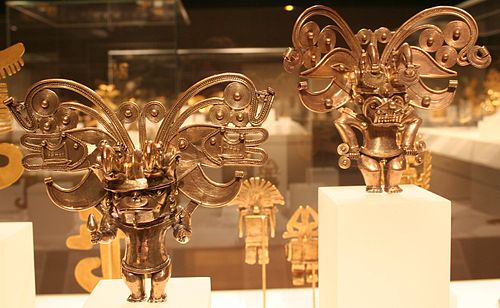
Tairona figure pendants in gold.

San Agustín Archaeological Park (UNESCO World Heritage Site), contains the largest collection of religious monuments and megalithic sculptures in Latin America and is considered the world's largest necropolis.
Colombia
Videos
Colombia, officially the Republic of Colombia, is a country located in South America, with insular regions in North America. Colombia's mainland is bordered by the Caribbean Sea to the north, Venezuel
Indigenous peoples in Colombia
…en Colombia), also known as Native Colombians (Spanish: Colombianos nativos), are the Indigenous peoples of the Americas whose ancestors lived in Colombia before the 16th-century Spanish colonization of Colombia. Estimates of the percentage of Colombians who are Indigenous vary, from 3% or 1.5 million to…

Vasco Núñez de Balboa, founder of Santa María la Antigua del Darién, the first stable European settlement on the continent

An illustration of the Battle of Cartagena de Indias, a major Spanish victory in the War of Jenkins' Ear

The departments of Gran Colombia in 1824

The Bogotazo in 1948