Induction motor
Videos
An induction motor or asynchronous motor is an AC electric motor in which the electric current in the rotor that produces torque is obtained by electromagnetic induction from the magnetic field of the stator winding. An induction motor therefore needs no electrical connections to the rotor. An induction motor's rotor can be either wound type or squirrel-cage type.

Three-phase totally-enclosed fan-cooled (TEFC) induction motor with end cover on the left, and without end cover to show cooling fan on the right. In TEFC motors, interior heat losses are dissipated indirectly through enclosure fins, mostly by forced air convection.
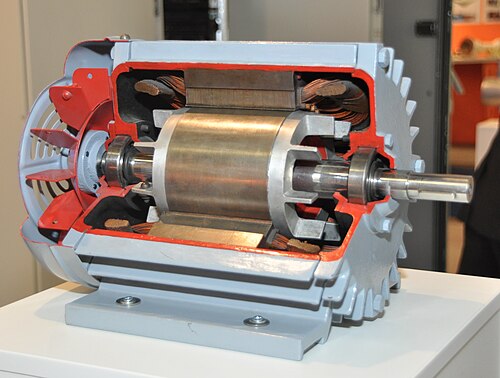
Cutaway view through stator of TEFC induction motor, showing rotor with internal air circulation vanes. Many such motors have a symmetric armature, and the frame may be reversed to place the electrical connection box (not shown) on the opposite side.

A model of Nikola Tesla's first induction motor at the Tesla Museum in Belgrade, Serbia

Squirrel-cage rotor construction, showing only the center three laminations
Magnetic field
Videos
A magnetic field is a physical field that describes the magnetic influence on moving electric charges, electric currents, and magnetic materials. A moving charge in a magnetic field experiences a force perpendicular to its own velocity and to the magnetic field. A permanent magnet's magnetic field pulls on ferromagnetic materials such as iron, and attracts or repels other magnets. In addition, a nonuniform magnetic field exerts minuscule forces on "nonmagnetic" materials by three other magnetic effects: paramagnetism, diamagnetism, and antiferromagnetism, although these forces are usually so small they can only be detected by laboratory equipment. Magnetic fields surround magnetized materials, electric currents, and electric fields varying in time. Since both strength and direction of a magnetic field may vary with location, it is described mathematically by a function assigning a vector to each point of space, called a vector field.
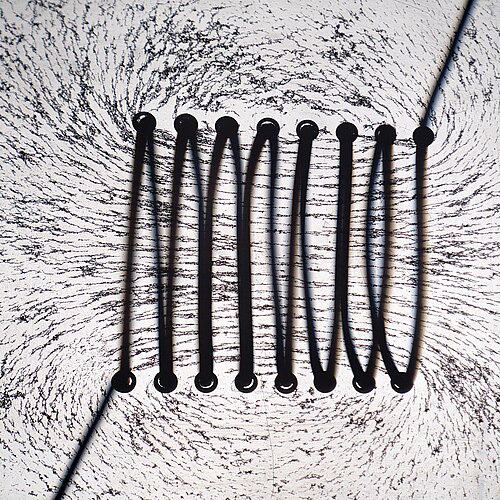
A solenoid (electromagnet), a coil of wire with an electric current through it

One of the first drawings of a magnetic field, by René Descartes, 1644, showing the Earth attracting lodestones. It illustrated his theory that magnetism was caused by the circulation of tiny helical particles, "threaded parts", through threaded pores in magnets.

Hans Christian Ørsted, Der Geist in der Natur, 1854