Insect wing
Videos
Insect wings are adult outgrowths of the insect exoskeleton that enable insects to fly. They are found on the second and third thoracic segments, and the two pairs are often referred to as the forewin

Original veins and wing posture of a dragonfly
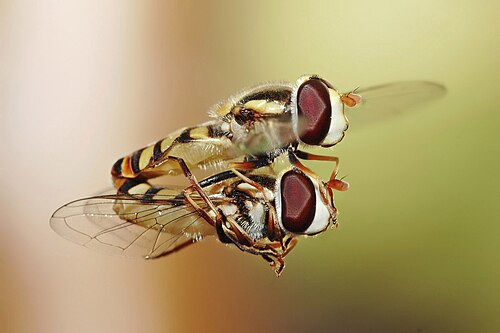
Hoverflies hovering to mate

A cockchafer's hardened forewings raised, hindwings unfolding

Outstretched wing of a bumblebee
Fly
Videos
A fly is an insect of the order Diptera, named for the single pair of wings. The hindwings have evolved into halteres, organs that sense rotation, giving flies precise control of their flight. Diptera


An Anthomyiid species showing characteristic dipteran features: large eyes, small antennae, sucking mouthparts, single pair of flying wings, hindwings reduced to clublike halteres

Fossil brachyceran in Baltic amber. Lower Eocene, c. 50 million years ago

Fossil nematoceran in Dominican amber. Sandfly, Lutzomyia adiketis (Psychodidae), Early Miocene, c. 20 million years ago