International Ultraviolet Explorer
Videos
Photos
International Ultraviolet Explorer, was the first space observatory primarily designed to take ultraviolet (UV) electromagnetic spectrum. The satellite was a collaborative project between NASA, the United Kingdom's Science and Engineering Research Council and the European Space Agency (ESA), formerly European Space Research Organisation (ESRO). The mission was first proposed in early 1964, by a group of scientists in the United Kingdom, and was launched on 26 January 1978 aboard a NASA Thor-Delta 2914 launch vehicle. The mission lifetime was initially set for 3 years, but in the end it lasted 18 years, with the satellite being shut down in 1996. The switch-off occurred for financial reasons, while the telescope was still functioning at near original efficiency.

A shell of a control and display unit for the International Ultraviolet Explorer (IUE) satellite, preserved in the Steven F. Udvar-Hazy Center.

Fully assembled IUE with the telescope tube on top and solar panel extended

Delta 2914 launching IUE spacecraft on 26 January 1978 from Kennedy Space Center.
European Space Agency
Videos
Photos
The European Space Agency (ESA) is a 22-member intergovernmental body devoted to space exploration. With its headquarters in Paris and a staff of around 2,200 people globally as of 2022, ESA was founded in 1975. Its 2024 annual budget was €7.8 billion.

Main control room of the European Space Operations Centre in Darmstadt, Germany

ESTEC buildings in Noordwijk, Netherlands. ESTEC was the main technical centre of ESRO and remains so for the successor organisation (ESA).
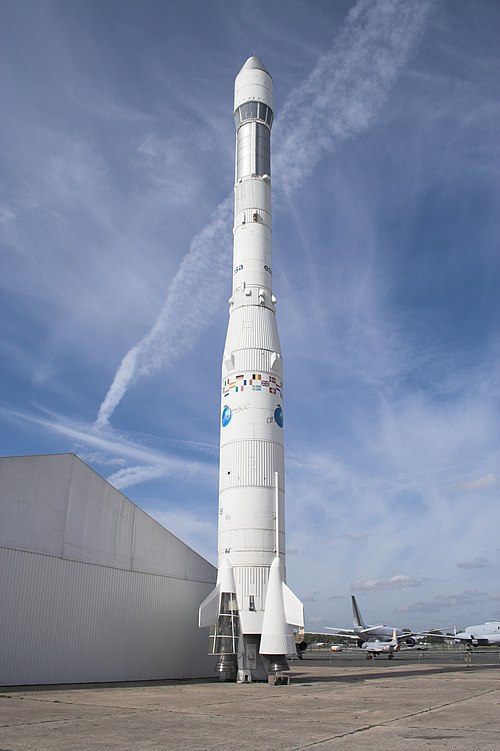
Mock-up of the Ariane 1

Vega rocket