Interplanetary dust cloud
Videos
The interplanetary dust cloud, or zodiacal cloud, consists of cosmic dust that pervades the space between planets within planetary systems, such as the Solar System. This system of particles has been

The interplanetary dust cloud illuminated and visible as zodiacal light, with its parts the false dawn, gegenschein and the rest of its band, which is visually crossed by the Milky Way, in this composite image of the night sky above the northern and southern hemisphere
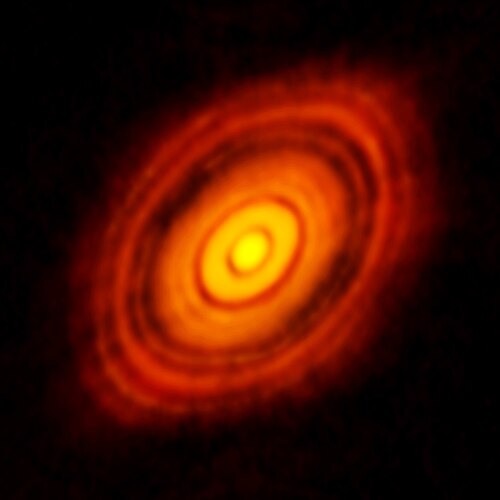
An image of a protoplanetary disk, comparable to images of simulations of the Solar System's interplanetary dust cloud, which has been suggested to be imaged from beyond it in the Outer Solar System.

Artist's concept of a view from an exoplanet, with light from an extrasolar interplanetary dust cloud
Helios Dust Instrumentation
Videos
The Helios 1 and 2 spacecraft each carried two dust instruments to characterize the Zodiacal dust cloud inside the Earth’s orbit down to spacecraft positions 0.3 AU from the sun. The Zodiacal light in
Schematic view of the Helios spacecraft with the three photometers (P15, P30, and P90) of the Zodiacal light instrument and the two sensors of the Micrometeoroid analyzer. The hatched areas indicate the respective field of view.


Bottom view of the Helios spacecraft. The three Zodiacal light photometers P15, P30, P90 show the black openings of their stray light baffles. The drift tube of the South (S) micrometeoroid sensor is seen next to the photometers.

P30, one of the three small photometers making up the zodiacal light instrument. In operation, the light enters from upper right through the black Carbon fibre stray light suppressing baffle.

Display of the South and Ecliptic sensors and the common electronics box of the Helios Micrometeoroid Analyzer.