Inzak was the main god of the pantheon of Dilmun. The precise origin of his name remains a matter of scholarly debate. He might have been associated with date palms. His cult center was Agarum, and he is invoked as the god of this location in inscriptions of Dilmunite kings. His spouse was the goddess Meskilak. A further deity who might have fulfilled this role was dPA.NI.PA, known from texts from Failaka Island.
Replica of the Durand Stone, inscribed with a formula mentioning Inzak. Bahrain National Museum.
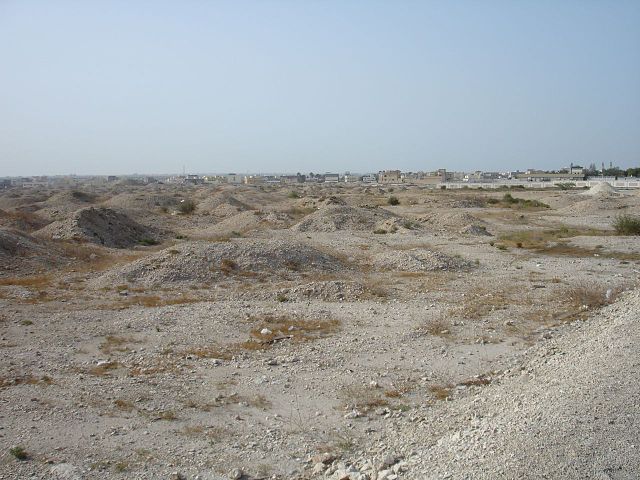
The Dilmunite burial mounds in A'ali.
Dilmun, or Telmun, was an ancient East Semitic-speaking civilization in Eastern Arabia mentioned from the 3rd millennium BC onwards.
Based on contextual evidence, it was located in the Persian Gulf, on a trade route between Mesopotamia and the Indus Valley civilisation, close to the sea and to artesian springs. Dilmun encompassed Bahrain, Kuwait, and eastern Saudi Arabia. This area is certainly what is meant by references to "Dilmun" among the lands conquered by King Sargon II and his descendants.
Votive relief of Ur-Nanshe, king of Lagash: one of the inscriptions reads, “boats from the (distant) land of Dilmun carried the wood (for him)”, which is the oldest known written record of Dilmun and importation of goods into Mesopotamia.
Receipt for garments sent by boat to Dilmun in the 1st year of Ibbi-Sin's rule, circa 2028 BCE. British Museum BM 130462.
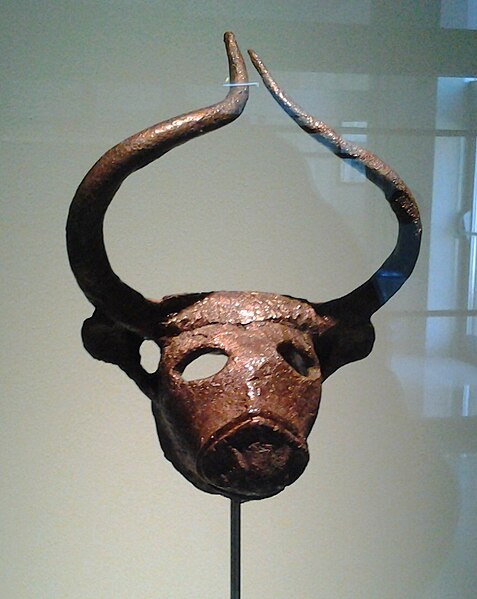
Bull's head, made of copper in the early period of Dilmun (ca. 2000 BC), discovered by Danish archeologists under Barbar Temple, Bahrain.
Correspondence between Ilī-ippašra, the governor of Dilmun, and Enlil-kidinni, the governor of Nippur, ca. 1350 BC